

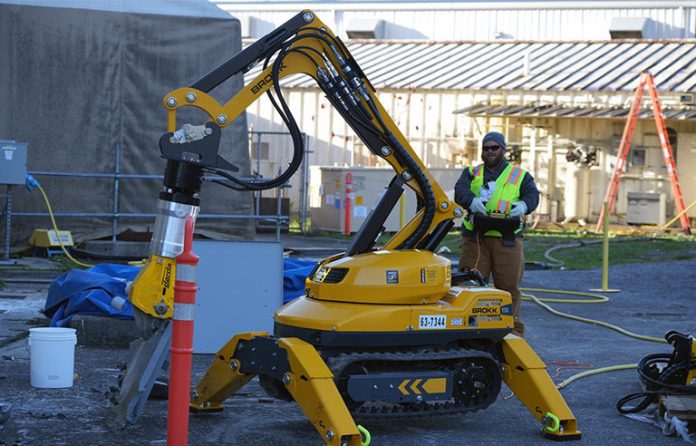
Oak Ridge, TN — Contract workers are testing new remote equipment designed to help them avoid “some of the most challenging, contaminated environments” involving radioactive material during deactivation and demolition projects at the Oak Ridge National Laboratory, the U.S. Department of Energy says.
Originally known as Clinton Laboratories, ORNL was established in 1943 to conduct the pilot-scale production and separation of plutonium for the World War II Manhattan Project. The laboratory was also highly involved in reactor designs and isotope research and production.
A DOE press release says that a remote demolition unit, which has been tested at Oak Ridge’s Experimental Gas-Cooled Reactor, allows workers to “significantly increase their distance from potential hazards,” reducing exposure and making work safer.
The workers have conducted mock-ups with the robotic system to prepare to support deactivation and removal activities at the former Radioisotope Development Laboratory, where the last of six hot cells – the highly radioactive subcell A – is being deactivated. DOE describes hot cells as “heavily shielded concrete rooms that provided researchers protection from radioactive material as they conducted research.” Built in 1945, the facility had been used to support isotope separation and packaging, along with examining irradiated reactor fuel experiments and components.
The system will be used to reduce the size of contaminated items in the cell, load them into containers and prepare the debris for final packaging and disposal. The equipment will also be used to remove a contaminated stainless-steel liner in the hot cell before demolition.
The project is scheduled to be completed sometime next year, DOE says.
“The great thing about remote demo equipment is the focus on safety for the team by keeping them out of the hazard area,” Scott Ward, cleanup and deactivation and demolition engineering manager for UCOR, a contractor on the project, said in the release. “This style of deactivation and demolition is critical for the future of cleanup in Oak Ridge.”

