
Responding is Henry Verdine, content marketing specialist, DuraLabel, Beaverton, OR.
Facilities face a constant balancing act when maintaining safety labeling that stays both compliant and durable over time. Regulations evolve, environments degrade materials and operational demands make consistency difficult to sustain. Even well-designed labeling systems can fail in real-world conditions, leading to safety risks, compliance gaps and costly rework.
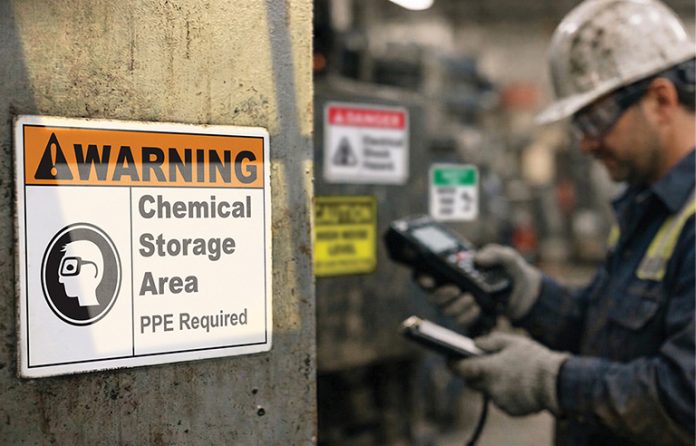
One of the most persistent challenges is environmental wear and tear. Industrial settings expose labels to extreme heat, moisture, chemicals and physical abrasion. Over time, labels fade, peel or fail completely. For example, in a manufacturing plant, labels may encounter oils, solvents and repeated handling. Without sufficient durability, the message becomes unreadable, increasing the risk of incidents and slowing down maintenance tasks. In high-traffic areas, even routine contact from tools or equipment can accelerate this degradation.
Regulatory complexity creates another major hurdle. Facilities must meet standards such as those from OSHA, the American National Standards Institute, the Globally Harmonized System of Classification and Labeling of Chemicals, and the National Fire Protection Association – each with its own requirements for label format and visibility. These standards evolve, requiring teams to review and replace outdated labels across large operations. For multi-site organizations, keeping labeling consistent across locations becomes even more difficult without centralized control or clear documentation processes. Gaps in documentation can lead to failed audits or delayed corrective actions.
Operational changes add further pressure. Work environments change frequently. Construction sites shift layouts, manufacturing lines are reconfigured and warehouses reorganize inventory. Each change can require updated labeling. When updates lag behind operations, compliance gaps appear and workers may rely on outdated or incorrect information, increasing the likelihood of errors.
Surface and application challenges also play a role. Labels often need to adhere to rough, oily or uneven surfaces. Poor adhesion leads to lifting or failure, especially on vibrating equipment or dusty infrastructure. In environments with frequent washdowns or outdoor exposure, labels must also withstand water, ultraviolet rays and temperature swings without degrading. Improper surface preparation often worsens these issues.
Facilities also face resource and training limitations. Safety teams often manage labeling alongside other responsibilities, while workers must quickly understand and trust label messaging. Inconsistent or degraded labels reduce confidence, and unclear messaging can slow response times during critical tasks or emergencies. Training gaps can further reduce the effectiveness of even well-designed labeling systems.
A lack of standardization creates inefficiencies. When teams use different formats or messaging, labels lose clarity. This can cause confusion during audits or emergencies, where quick decisions matter. It can also lead to duplicated efforts when teams recreate similar labels without shared standards.
Maintenance and lifecycle management are often overlooked. Labeling requires regular inspection, documentation and scheduled replacement. Without a proactive process, issues go unnoticed until an inspection or incident exposes them under pressure and with greater consequences. Reactive replacement cycles tend to increase costs and disrupt operations.
These challenges rarely occur in isolation. Facilities that treat labeling as an ongoing system rather than a one-time task are better positioned to maintain compliance, improve safety and adapt to changing conditions over time.
Editor’s note: This article represents the independent views of the author and should not be considered a National Safety Council endorsement.