
Atlanta — Researchers have developed a computer model designed to estimate chemical-vapor buildup in confined spaces, which could help address exposure concerns after on-the-job chemical spills.
A team from Georgia Tech drew on experiences from a course in which students aimed to close “a gap between research labs and reality,” a press release states. It outlined its methods in a recent study.
When chemical spills occur, “you need that safety data right away,” Jenny Houlroyd, study co-author and occupational group health manager of the university’s Enterprise Innovation Institute Safety, Health and Environmental Services Program, said in the release.
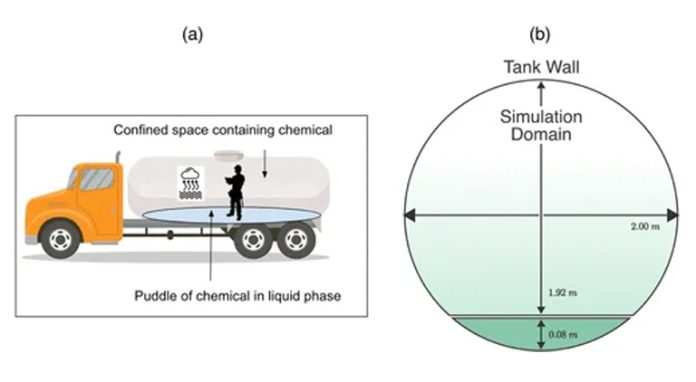
The group simulated how chemicals spread and evaporate after spilling in enclosed environments such as tanker trucks. They chose the carcinogenic chemical compound benzene and input information into an open-source software program.
The simulations accounted for various factors to determine the time required for vapors to reach certain heights, depending on whether a person was crouching or standing. Findings show that the model “can provide conservative and precise time-resolved estimates” of chemical vapors in confined spaces.
However, the researchers say the method should be regarded as a complement, not a replacement, to physical chemical sampling devices.
“We’re addressing important gaps in modeling chemical exposure,” John Pederson, study co-author and a doctoral student in chemistry, said in the release. “There’s been strong work in industrial settings but less attention to environments found in transportation, agriculture and sanitation, for example.
“It’s an easily overlooked fact that working with paints, coatings, cleaning solutions and other solvents presents a risk of acute or chronic exposure.”
The team said it intends to create a mobile app to allow the model “to be useful and widely available for all safety professionals and practitioners.”
The study was published in the journal ACS Chemical Health & Safety.