

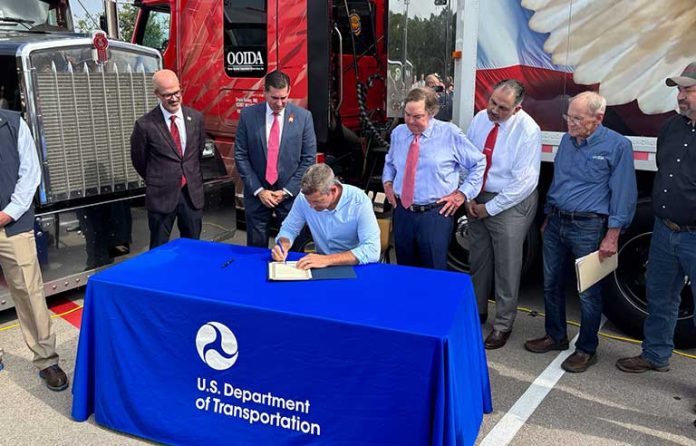
Washington — Proficiency in speaking and reading English “should be a nonnegotiable safety requirement” for commercial truck drivers in the United States, according to an Executive Order recently issued by President Donald Trump.
As part of the order, Transportation Secretary Sean Duffy on May 20 rescinded a June 2016 guidance document from the Federal Motor Carrier Safety Administration that didn’t include federal requirements for truck drivers to be proficient in English.
Under updated policy, FMCSA inspectors will gauge English proficiency through a driver interview and an assessment of highway traffic sign recognition. Drivers will be placed out of service for failing the test. Policy states that inspectors need not proceed to the highway signs assessment if they believe a driver is “unable to respond sufficiently” to interview questions.
“Allowing drivers who cannot read stop signs or understand police officers’ instructions to operate [an] 80,000-pound big rig threatens the safety of every American on our roadways,” Duffy said May 20 while announcing the measure in Austin, TX.
Various trucking industry groups have responded to the order. The Commercial Vehicle Safety Alliance announced that it will add English proficiency to its driver out-of-service criteria.
Effective June 25, drivers who “cannot read and speak the English language sufficiently to communicate with the safety official to respond to official inquiries and directions in accordance with FMCSA enforcement guidance” will be placed out of service, CVSA says.
Provisions of the Code of Federal Regulations outline English proficiency as a general qualification for drivers. Under 49 CFR 391.11(b)(2), a driver is qualified to operate a motor vehicle if they “can read and speak the English language sufficiently to converse with the general public, to understand highway traffic signs and signals in the English language, to respond to official inquires, and to make entries on reports and records.”
Multiple reports state that FMCSA’s decision in 2016 to remove federal out-of-service requirements for driver English proficiency stemmed from the agency’s inability to “substantiate the safety impacts” of the rule.
However, an FMCSA press release issued last month cites “documented cases where drivers’ inability to read our signs and speak our language may have contributed to a series of fatal accidents.”
Those include a 2019 incident in which a truck driver passed multiple signs warning of steep grades and dangerous curves while approaching speeds of 100 mph. The driver collided with multiple vehicles in a crash that resulted in four deaths and multiple injuries.
In January, “a fatal collision in West Virginia involved a driver fleeing another accident who required an interpreter for the post-crash investigation,” the release adds.
Duffy said in the release that “this commonsense standard should have never been abandoned.”
In April, Rep. Harriet Hageman (R-WY) and American Trucking Associations President and CEO Chris Spear sent separate letters to Duffy asking him to address the issue.
“We thank the Trump administration for responding to our concerns on the uneven application of this existing regulation, and we look forward to working with FMCSA and the law enforcement community on an objective, consistent and effective enforcement standard,” Dan Horvath, senior vice president of regulatory and safety policy at ATA, said in a press release.

