

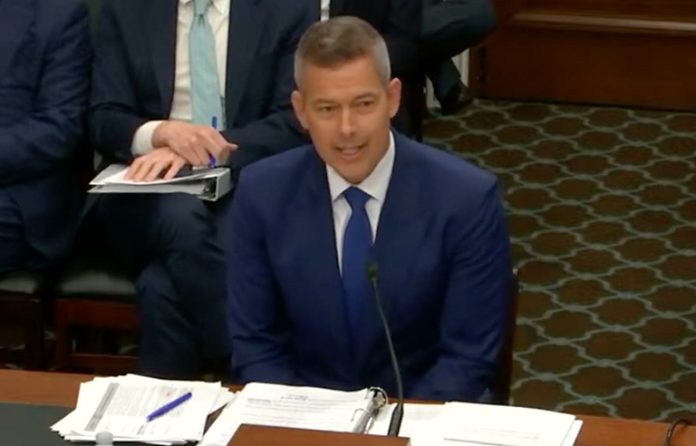
Washington — Improvements to the safety and efficiency of the U.S. airspace must happen at an “expedited speed,” Transportation Secretary Sean Duffy testified during a Senate Transportation, Housing, Urban Development and Related Agencies Appropriations Subcommittee hearing, adding that opportunities to “pay these investments forward” will be many.
The May 15 hearing addressed the Department of Transportation’s fiscal year 2026 budget request.
The White House is seeking to allocate $26.7 billion – a 5.8% increase from the previous fiscal year – for DOT. That total includes $18 billion for the Federal Aviation Administration to hire and train new air traffic controllers and update air traffic facilities and radar.
“I think this is a moment in time that we can all work together to make the critical investments and execute on those investments safely but in a really fast time frame,” Duffy said. “We can’t wait five, 10, 15 years to do this.”
Lawmakers agreed with the urgency to improve aviation safety during the May 15 hearing, as well as during a May 14 House Transportation, Housing, Urban Development and Related Agencies Appropriations Subcommittee hearing, in which Duffy also testified.
Family members of the late Sam Lilley, 28, attended both hearings. Lilley was serving as first officer aboard a commercial airliner on Jan. 29 when the plane collided with a U.S. Army Black Hawk helicopter, an incident that killed 67 people in the nation’s capital.
Another high-profile aviation incident occurred on May 5-6, as hundreds of flights into and out of Newark Liberty International Airport were either delayed or canceled, according to the flight tracking website FlightAware. Multiple reports cited several compounding issues behind the delays, including an air traffic controller staffing shortage, aging technology and inclement weather.
A February report from the Flight Safety Foundation shows that 268 people were killed in airline incidents last year. That marked the most since 2019, when 280 deaths were recorded, and more than doubled the 2023 total of 110.
Cuts to the federal workforce
During both hearings, Duffy defended President Donald Trump’s initiative to downsize the federal workforce, saying it was possible to “do more with less” without compromising safety.
Sen. Patty Murray (D-WA) challenged that assertion.
“You know, we just don’t need fewer people keeping trains on the track or making sure that the airbags work or rebuilding our roads and public transit systems; we actually need more of them,” she said during the May 15 hearing. “And in recent months, as we’ve heard already, we’ve seen unacceptable chaos at the Newark Airport, the devastating crash [in Washington] and a lot of other close calls.
“And while you talk about modernizing the air traffic control system, you have forced out more than 2,000 FAA employees who support those air traffic controllers – the technicians, the mechanics, the engineers, the IT specialists at the FAA who were working on modernization. Which I think is a huge mistake and you just can’t paper over it.”
Duffy responded: “I would disagree with much of what you said. … I would say we don’t have a support staff issue with the FAA; we don’t have enough controllers for the skies that we have in America. So that is the issue that I’m addressing.”
On May 1, Duffy announced a plan that includes strategies to attract more ATCs and incentivize existing controllers to remain in their positions.
Rep. Steve Womack (R-AR), chair of the House subcommittee, said he wanted “to make sure we address a bit of an elephant in the room” during the May 14 hearing.
“This administration has undertaken efforts to seriously overhaul the federal bureaucracy while also taking a hard look at where our taxpayer dollars are being spent,” he said.
“This is a valiant effort that our House majority is supportive of, but I want to make something clear: Efforts to restructure the Department of Transportation without congressional approval, to not execute programs appropriated by this committee, or to not give proper congressional notification when awarding or amending grants concerns me.”
Sen. Cindy Hyde-Smith (R-MS), chair of the Senate subcommittee, told attendees May 15 that senators must submit additional questions within seven days of the hearing. The subcommittee requested DOT responses within 30 days.

