

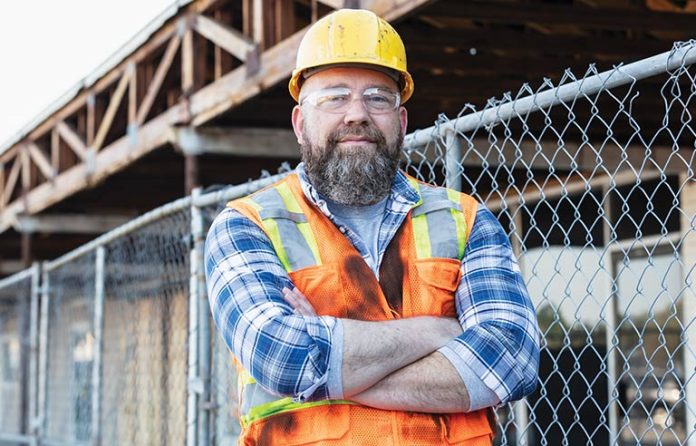
Looming deadlines and financial pressures. The physical toll on the body.
Experts say these and other stressors have contributed to an alarming rate of suicide in the construction industry.
Data from the Centers for Disease Control and Prevention shows that construction occupations are second only to the mining, quarrying, and oil and gas extraction industry for suicide rates.
Complicating the problem further is the macho culture, prevalent in the construction industry, that may make workers less willing to talk about their mental health struggles.
“All of the things that we love about construction workers – that strong, rugged exterior and the get-it-done-at-all-costs mentality – are also the things that keep our workers from asking for help,” said Sonya Bohmann, executive director of the Construction Industry Alliance for Suicide Prevention. “They’re the things that make people feel like if they do need someone’s support, then they’re weak or they’re selfish because they can’t do it themselves.
“And that’s a big piece of why this issue is pervasive still.”
Take an active role
When CDC data first began pointing to a suicide crisis in construction, employers who wanted to help workers struggling with mental health weren’t always sure about how to reach out and be supportive, said Bob McCall, director of safety at the Master Builders’ Association of Western Pennsylvania Inc.
“That’s where, in a lot of respects, the industry fell short when we first started mentioning this,” McCall said. “Yeah, we realized we had a problem, but we didn’t have solutions for it. We’d hang a poster on the wall and say, ‘Call this number,’ and nobody was really paying attention to that poster.”
Now, McCall can name numerous programs intended to help construction workers and employers take an active role in suicide prevention, including those from OSHA, CPWR – The Center for Construction Research and Training, and the Construction Industry Alliance for Suicide Prevention.
Another one of those programs: In 2023, MBA and the Constructors Association of Western Pennsylvania partnered to form “Yinz Good?” – a mental health initiative for construction workers. (“Yinz” is a plural of “you” in the western Pennsylvania regional dialect.)
Common among these programs is an emphasis on early intervention – “getting people help with the issues that become contributing factors before it is a problem,” McCall said – and offering open, concrete guidance and solutions.
“You can’t just say, ‘Yeah, I know it’s hard,’ and leave it at that,” McCall said. “You actually have to be able to say, ‘Yeah, I know it’s hard. Here’s where we can get you some help. Here’s somebody you can talk to.’”
Sonya Bohmann
Executive director
Construction Industry Alliance for Suicide Prevention
Risk factors and warning signs
The American Foundation for Suicide Prevention says that “while there is no single cause for suicide, there are risk factors and warning signs which may increase likelihood of an attempt.”
They include:
- Access to lethal means such as firearms and drugs
- Aggression, mood changes and poor relationships
- Anxiety
- Bipolar disorder
- Depression
- Exposure to another person’s suicide
- Prolonged stress or stressful life events
- Previous suicide attempts or family history of suicide
- Serious physical health conditions, including pain
- Substance misuse
AFSP also advises employers to pay attention to whether a person has discussed killing themselves, having no reason to live, feeling hopeless or trapped, or experiencing unbearable pain.
The foundation offers additional warning signs related to someone’s behavior and mood:
- Agitation/anger/irritability
- Giving away prized possessions
- Humiliation/shame
- Isolating from family and friends
- Visiting or calling people to say goodbye
- Withdrawing from activities
What needs to change?
Normalizing respectful conversation and comfortable communication around worker mental health concerns is vital, experts say.
“That’s going to be the biggest change we have to make, and it’s going to be the hardest one to make, is to get the culture shift to happen,” Bohmann said. “I think that, now more than ever, people are willing to have the conversation. We have lots of companies that are starting to make mental health part of their safety plan, but there’s still a long way to go.”
In August, the Building Trades Employers’ Association – which represents around 1,200 contractors in New York City – called on local, state and federal leaders to establish reforms intended to increase mental health awareness in construction.
The proposed reforms include:
- Incorporating mental wellness into OSHA 10- and 30-hour training courses.
- Requiring mental wellness discussions during onsite safety orientations.
- Requiring larger construction sites to have naloxone available to treat opioid overdoses.
If you’re concerned about a co-worker, talk with them privately, OSHA advises. Speaking during a video published by the Mechanical Contractors Association of America in January 2024, Sally Spencer-Thomas, a psychologist and international speaker on mental health awareness and suicide prevention, encourages starting conversations with an expression of care:
“I care about you. You matter to me.”
Ask the co-worker to tell you what’s going on, then listen with empathy and compassion.
If a common question in these conversations receives a pat answer, it’s OK to pause and be persistent.
“You do have to just ask, ‘Are you good?’ And most people will say, ‘Yeah, I’m fine, I’m good. Everything’s fine,’” Bohmann said. “And so, you have to ask again, and you have to wait and you have to listen, and when they say, ‘I’m fine,’ again, then you have to go back to those warning signs that you recognized and integrate them into that conversation. ‘Well, I know you said that you’re fine, but you’re not usually late for work and you’re not usually jumping into conflict with our other co-workers. I’m really concerned about you because sometimes when someone gives away all of their possessions or the things that are most important to them, they’re thinking of suicide. Are you thinking of suicide?’
“You have to ask very bluntly and very openly – with compassion, obviously – but you can’t dance around that, ‘Are you thinking of hurting yourself?’ You have to be very clear with the question because what that does is it creates some space. It creates a change in that thought pattern for the person.”
Create a ‘culture of care’
Do you think a co-worker is at immediate risk of suicide? OSHA says to contact emergency services or the National Suicide Prevention Lifeline number – 988 – and stay with them until help arrives.
If the concern is less immediate, the agency advises encouraging the co-worker to contact the organization’s employee assistance program, member assistance program, human resources department or a mental health professional.
“Yinz Good?” also promotes peer counseling. McCall said program organizers found that workers were more prone to speak openly with and feel better understood by someone with shared work experiences.
“When you have these conversations, it’s a more personal conversation and it’s a more realistic conversation because these folks have had these issues and they can actually actively speak on what is the solution that worked for them,” he said.
Whatever the avenue or resource, “it’s really about creating a culture of care, making sure that everyone talks about it, whether it’s our executive level to our midlevel managers to our craftspeople,” Bohmann said. “Suicide, it doesn’t discriminate, and it doesn’t target one sector of our industry. Top to bottom, everyone is affected.”
In that respect, anyone on a jobsite or in an organization can make a difference by properly and respectfully approaching a co-worker who may need assistance with mental health concerns.
“You don’t have to be a licensed clinical social worker,” Bohmann said. “You don’t have to be an HR professional. You don’t have to be a safety professional. Everybody can do something in and around this conversation.”

