


OSHA conducts around 35,000 workplace inspections each year. Not surprisingly, some
cases stand out more than others – and offer lessons to help prevent similar incidents.
A few years ago, Safety+Health began publishing some of the cases the agency considers its “most interesting.” The series – consisting of content from a now-annual Technical Session at the NSC Safety Congress & Expo – has continued to be popular. So, we’re bringing it back for another year. Check out the most recent cases, presented in September by four of OSHA’s experts:
Here are the cases they presented.
1
Carbon monoxide exposure
Shawn Merillat, industrial hygienist
Wichita, KS
2
Workplace violence
Christopher Stitcher, safety specialist
Jacksonville, FL
3
Heat-related illness
Alex Daniels, industrial hygienist
Lubbock, TX
4
Combustible dust explosion
Nicole O’Connor, assistant area director
Madison, WI

Page 2 of 5
Carbon monoxide exposure
Thirty workers at a meatpacking facility were poisoned after an employee replaced a cylinder of a tri-gas blend with one containing only carbon monoxide.
Presented by Shawn Merillat, industrial hygienist, Wichita, KS
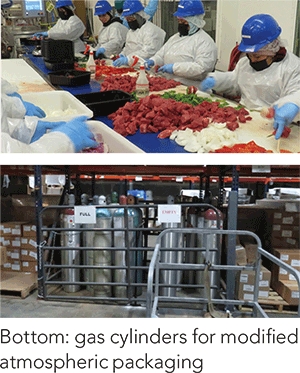
The facility used modified atmosphere packaging to help extend the shelf life of its products. Normally, that process relied on a blend of nitrogen, carbon dioxide and 0.41% carbon monoxide to package beef products.
“Unfortunately, before the incident occurred, the employer stored all of the cylinders in the same cage,” Merillat said.
The packaging line ran for about 20 minutes before numerous employees needed assistance to leave the facility. Sixteen of the workers were transported to hospitals and six were admitted, including two pregnant employees.
Investigation details
Merillat said the employees had no training on the chemicals they were using or how to read hazard communication labels. In addition, the facility wasn’t equipped with carbon monoxide sensors or alarms.
OSHA issued eight serious citations – five related to the carbon monoxide release.
“Had that machine been running a little bit faster, had the exposure period lasted a little bit longer or the room been a little bit smaller, we could have had 30 fatalities,” Merillat said.
Lessons learned
- Failure to implement basic controls can result in catastrophic consequences.
- Even the most routine aspects of a safety and health program are crucial.
Page 3 of 5
Workplace violence
An assault on a nurse led to the discovery of other incidents at a behavioral health facility.
Presented by Christopher Stitcher, safety specialist, Jacksonville, FL

OSHA’s investigation was initiated after three online complaints were submitted in one week. The complaints all stemmed from one incident, in which a patient punched a nurse in the back of the head, knocking her unconscious.
Although the facility had “extensive records” of workplace violence, Stitcher said those records were considered confidential under the Patient Safety and Quality Improvement Act of 2005.
With the investigation starting at “square one,” Stitcher obtained a subpoena for a list of past and present employees, which included their phone numbers. OSHA could then use the list to connect names with dates and injuries revealed during its interviews with employees.
OSHA’s investigation found seven additional incidents of workplace violence, but only four within the six-month jurisdictional window of an agency investigation. That included one incident that occurred during the investigation. (An interim director of nursing was kicked in the groin.)
General Duty Clause citations, all serious, were issued for the four incidents.
Investigation details
The investigation revealed that the employer had a training program on workplace violence prevention, “but” it was a “check the box” program and ineffective at simulating real-world situations.
Employees had a way of getting help during a workplace violence incident, “but it was to simply yell.”
Stitcher said: “This wasn’t always effective, such as when a patient would get an employee in a chokehold, which was shown to happen, or if [an employee was] far from the nurses’ station or they’re alone in a room with a patient.”
The employer had a workplace violence committee, “but” the makeup of the committee gradually became heavy on senior management and supervisors. The workers “had no voice in which to bring up safety issues,” Stitcher said.
The employer also had a system of notifying incoming employees during shift changes about any workplace violence incidents that occurred during the day, “but” it was inconsistent. Employees often wouldn’t receive adequate information about patients’ violent incidents or behaviors.
“The biggest issue was the employer’s aloofness,” Stitcher said. “They were filling out forms and recording these incidents, but they were doing nothing to prevent them. They felt violence was just part of the job.”
Resolution
The employer took abatement “very seriously” after the investigation. Among the steps taken:
- Developed a 177-page abatement plan that “wasn’t just fluff.”
- Retrained all employees.
- Issued “zebra phones” or panic buttons.
- Hired a consultant to review the workplace violence prevention program.
- Established a workplace violence prevention committee comprising frontline employees.
Lesson learned
- “I hope this presentation has shown the good that can come after an OSHA citation has been issued, if the employer takes abatement seriously,” Stitcher said. “I’ve heard from employees who have told me that since the inspection, they feel a lot safer.”
Page 4 of 5
Heat-related illness
A landscape worker suffered heatstroke after his body temperature reached 109° F.
Presented by Alex Daniels, industrial hygienist, Lubbock, TX
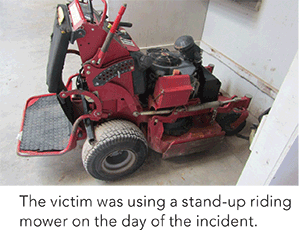
A two-man crew was assigned to residential mowing because both workers had been with the company for less than a week and that work required no heavy lifting or digging. During the afternoon, the heat index reached as high as 96° to 98° F and, sometime after 2 p.m., one of the workers was seen mowing the same spot in a yard over and over. His co-worker tried to see what was wrong, but the employee yelled at him to “mind his own business!”
“The employees did not call their supervisor,” Daniels said. “They did not call their manager. They did not call 911 or provide first aid, and they didn’t take a break.”
Later, the employee began vomiting and dry heaving before collapsing. He attempted to drive back to the company’s facility but didn’t have the strength to operate his vehicle. At 5:42 p.m., the employee started having seizures. He also had pale skin and dark lips, and had stopped sweating. His body was stiff and he was coughing up a “red tint.”
When he arrived at the hospital, his body temperature was 109° F. He spent 10 days in the hospital.
Investigation details
OSHA learned that the company had “some elements” of heat stress prevention but an extremely short written program:
“When working in extremely hot climates, be sure to drink plenty of liquids to avoid dehydration. Seek medical attention immediately if symptoms of overheating exist (hot skin, nausea, headache, dizziness, cramping, fatigue, etc.).”
Workers weren’t provided time to acclimatize to hot conditions and didn’t understand what the term “acclimatization” meant, Daniels said. New hires often were given lighter work (mowing residential lawns, for example), but they still worked a full day in the heat.
Employees did have access to water, coolers and an ice machine, and were allowed to take breaks “as needed” in an air-conditioned vehicle.
OSHA issued one serious violation of the General Duty Clause.
Resolution
The company created a more comprehensive heat stress prevention program. It also posted OSHA QuickCards on heat stress in each of its vehicles and displayed OSHA posters – in English and Spanish – on its walls.
Additionally, the company provided employees with cooling towels and discussed heat safety during new-employee orientation.
Lessons learned
- Training is a must: Employees should learn heat illness prevention, the signs and symptoms of heat illness, and “how to act immediately” when someone experiences a heat-related illness.
- Acclimatization: Nearly 3 out of 4 workers who die from heat-related causes are in their first week on the job. OSHA and NIOSH recommend the 20% rule for building heat tolerance: New employees should only have 20% of a normal workload on their first day, 40% on the next day, 60% on the day after, etc. That’s a rule of thumb, Daniels cautioned, and every employee is different. “If, on Day 3, an employee is running laps around everybody else, you can potentially shorten that acclimatization phase,” he said. “But if on Day 7 they’re still huffing and puffing, they’re still struggling, you obviously may need to extend that.”
- Day-to-day supervision: At least one employee should be responsible for monitoring conditions at a worksite and implementing the employer’s heat plan throughout the workday.
Page 5 of 5
Combustible dust explosion
Five workers were killed and 14 others were seriously injured.
Presented by Nicole O’Connor, assistant area director, Madison, WI
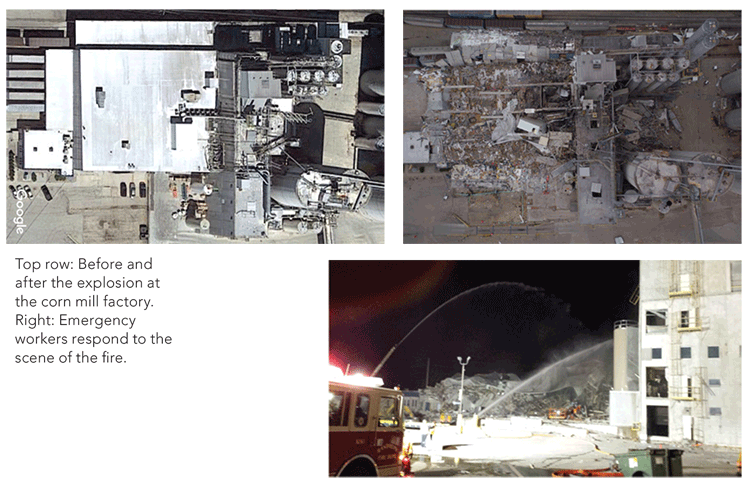
On the evening of May 31, 2017, a series of explosions occurred at a corn milling facility in rural Wisconsin. The blasts, caused by grain dust, left five workers dead and 14 others seriously injured. More than 40 fire departments responded, as did numerous emergency medical responders (including multiple helicopters) and law enforcement officers.
“Most of the workers coming out of the rubble were dazed and confused and had no idea what had happened,” O’Connor said. “Some of them came out with their clothes on fire, some with their clothing burned off of them and some with their hair still smoldering.”
Investigation details
Between 2010 and 2014, the company had been cited by OSHA for workers “entering bins improperly,” combustible dust issues, machine guarding issues and airborne overexposure to dust.
Business was “booming” because of a government contract to provide cornmeal to impoverished countries. The system for handling dust, however, couldn’t keep up with the increased volume.
The company also eliminated a sanitation crew to clean grain dust. This was done as a cost savings effort and because they had difficulty finding employees to perform the work. The sanitation duties were instead shifted to mill operators, but cleaning and preventive maintenance – which would have shut down production – took a back seat. Employees raised concerns about not having enough time to clean but were told to do the best they could. The workers often didn’t clean the upper levels of the facility, and housekeeping only happened when dust accumulations were identified.
“Imagine you have a highly combustible, explosive dust that once you get enough of it then you’re sending employees to go clean it up,” O’Connor said. “If you had gasoline pouring out during part of your process, would you wait until you had accumulated enough to start cleaning it up? You would want to stop that leak.”
The employer also decided workers’ blue flame-resistant clothing “looked terrible” when it got flour dust on it and would appear dirty to customers who came to the mill. Instead, they put the employees in white polyester clothing.
“The ER doctors said this caused those burns to be worse, as their uniforms melted to them,” O’Connor said.
The company didn’t have an emergency action plan, alarms or a universal radio channel to alert employees.
The aftermath
OSHA issued 19 citations, including eight willful and egregious violations, totaling $1.8 million in fines. The company also had to pay more than $10 million in restitution to victims and their families, and was fined another $1 million by the Department of Justice. Current and past company officials pleaded guilty to falsifying documents and obstructing an OSHA investigation. Two more company officials chose to go to trial. Both were convicted, each receiving two-year prison sentences, among other punishments.
Lessons learned
- If your facility generates dust, get it tested with a dust hazard analysis. “I continue to be surprised on our inspections what (dust) comes back as explosive,” O’Connor said. “If you have any dust, or anything that generates dust, you want to manage that.”
- Manage dust by locating sources of dust, stopping any leaks and keeping it in the pipes. The lightest dust, which often will ascend to the upper levels of a facility, is among the most dangerous.
- Ensure all ignition sources are controlled or eliminated.
- Take part in preventive maintenance on all equipment.
- Install protective systems and test them.

