Do you live where ice, snow and freezing rain are part of winter?
If so, you need to get your vehicle ready to handle the elements.
“The most important thing is to prepare,” said Ryan Pietzsch, program technical consultant for driver safety at the National Safety Council.
By taking time now to make sure your car is ready – and equipped with the right emergency supplies – you’ll be good to go when wintry weather strikes.
Let’s get started.
Fluid levels
In colder climates, your vehicle’s radiator needs antifreeze to keep the coolant safe. Frozen coolant can cause cracked engine blocks and frozen pipes – and lead to parts of the engine bursting.
Same goes for windshield wiper fluid – you don’t want it to freeze. Fill the reservoir with a winter-ready wiper fluid before outdoor temperatures get too low. If you add water to your vehicle’s windshield wiper fluid during the warmer months, it’s time to drain that and replace it with full-strength wiper fluid.
Tires
Do winter temps in your area consistently stay below 45° F? If so, Pietzsch suggests you switch to winter tires for better traction.
And speaking of traction: Make sure winter tires have at least 6/32 inches of tread for snowy and icy conditions (instead of the usual 4/32 inches for rain). An easy way to test is to place a quarter upside down inside the tread. If you can see all of George Washington’s head, your tires won’t perform well on snow and ice.
Air pressure matters, too. For every 10 degrees the temperature drops, tires can lose 1 pound per square inch, or PSI, of air pressure. That can affect your vehicle’s handling – and your safety. So, on cold days (especially when temps start out warm and turn cold), you should keep a close eye on your vehicle’s tire pressure.
Windshield wiper blades
It’s important to have properly functioning wiper blades to keep windshields clear! Check them often for signs of wear or damage and replace them when needed. Also, try to get into the habit of cleaning your windshield and wiper blades before heading out.
Emergency supplies
Part of planning ahead is putting together a vehicle emergency kit in case you become stranded. NSC says your kit should have the following items:
- Extra layers of clothing (including extra socks)
- Blanket
- Warm gloves, preferably mittens
- High-visibility vest or jacket
- Protein bars or other nonperishable food items
- First aid kit
- Portable power bank/cellphone charger
- Flashlight with extra batteries
- Rain gear
- Windshield washer fluid
- Bag of sand, rock salt or kitty litter to help with tire traction
- Shovel
- Tire chains
- Jumper cables or jumpstart charging system
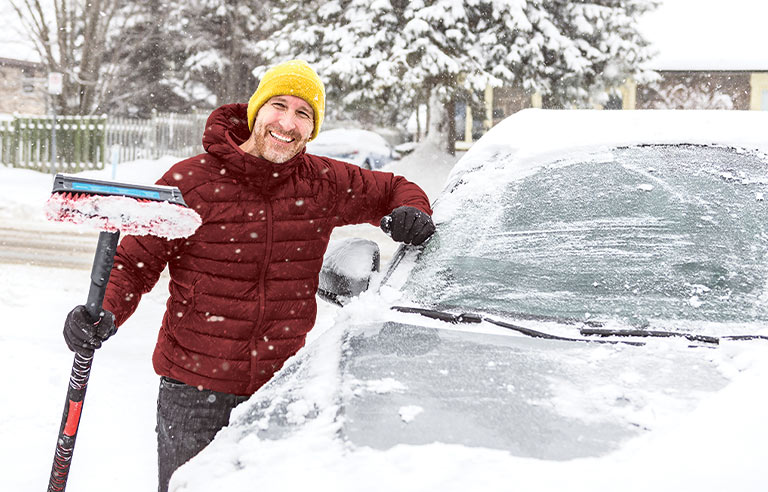
- Snow scraper and brush
- Extra flares and reflective triangles
The shovel can be used to keep snow from building up and clogging your vehicle’s tailpipe, which could lead to carbon monoxide poisoning.
The flares can serve not only as a distress signal but also as a lighter or heat source to melt snow or ice in an emergency, Pietzsch said.
You should also store in your cellphone the phone number of a roadside assistance service. And bring a water bottle or mug with you on car trips. Water that’s been stored in the trunk won’t help in freezing temperatures because it’ll be frozen when you need it.
Driving tips
Before hitting the road, clean off any snow or ice from your mirrors, windows, lights and cameras.
Do the same for sensors – they’re critical for automatic braking and other safety features.
NSC’s Defensive Driving Courses offers tips for driving in snowy and icy conditions:
- Slow down and increase your following distance. (That’s three seconds plus one second for every adverse condition: poor visibility or lighting, wet roads, slick roads, slush, traffic, etc.)
- Keep a firm grip on the wheel.
- Accelerate and brake slowly.
- Avoid sharp turns.
- Watch for brake lights on the vehicles ahead of you.
- Look out for cars hidden by poor visibility.
- Watch for drivers whose visibility may be limited – especially if their vehicle’s windshield or windows aren’t fully cleared of snow and ice.
- Be extra careful on bridges, overpasses and underpasses, which freeze faster than regular roads.
Pietzsch’s most important advice? Stay off the roads, whenever possible, if winter conditions make them risky. “The best choice you could possibly make is don’t drive.”