

Responding is Scott Margolin, vice president of technical at Tyndale Co., Pipersville, PA.
Technology has a habit of outpacing the understanding of hazards and safety, and direct current arc flash is no exception.
Although alternating current arc flash has been relatively well understood since the 1990s, less is known about DC arc flash – and existing information is often more theoretical than practical. Yet with the rapid growth of the electric vehicle and related industries – EV manufacturing, EV charging infrastructure, DC battery manufacturing, DC battery replacement/maintenance/repair, DC energy storage, DC-to-DC charging and more – DC power is expanding exponentially in the United States. And as the EV industry continues to expand, so does the importance of understanding and protecting workers from the potential hazards associated with DC electrical systems.
DC is different than AC in that it’s “on” throughout the arc, whereas AC current alternates “on” and “off” (where the curve crosses the zero point) once per cycle of the arc duration. DC arcs are theoretically harder to stop because they don’t drop below the zero point, but beyond that are far more questions than answers, including:
- What does a DC arc look like?
- How different are DC arcs vs. AC arcs?
- Are DC arcs more dangerous than AC arcs?
- How does common arc-flash PPE handle DC arcs?
- Are arc ratings determined based on an AC arc (using ASTM F1959) translatable to DC arc hazards?
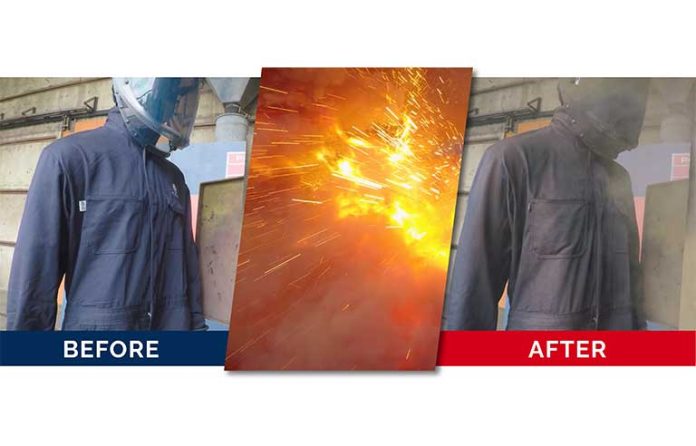
That is until a recent study. To help the industry by beginning to answer questions such as these, researchers leveraged the same laboratories and gear used for AC arc flash analysis to create DC arcs, placing manikins wearing existing arc-rated clothing technologies and nonprotective workwear in front of the arcs. Employing high-speed, super-slow-motion cameras to capture overhead and close-up views, the arcs – and their aftermath – were recorded and studied.
The first of its kind, this real-world DC arc research documents the devastating power of the DC arc hazard, demonstrating two facts critical to worker safety:
- DC arcs ignite flammable clothing, even at relatively low energy levels.
- Existing AR clothing effectively protects workers from DC arcs.
The study reinforces the importance of wearing AR clothing and appropriate PPE when an arc hazard – whether AC or DC – is present in your job environment. These findings are particularly significant because history has shown that most arc-flash injuries and fatalities are preventable – most often caused by people wearing fuel. If your job exposes you to a DC arc hazard, remember: Don’t wear fuel, and don’t leave home without AR clothing – your last line of defense.
To compare and contrast AC and DC arcs, witness the catastrophic outcome of wearing nonprotective clothing in a DC arc flash, and examine the critical role that proper AR clothing and PPE play in ensuring worker safety in the rapidly evolving world of EVs, visit tyndaleusa.com/fr-safety-resources/arc-flash-library/#DC to watch video footage from the testing.
Editor’s note: This article represents the independent views of the author and should not be considered a National Safety Council endorsement.

