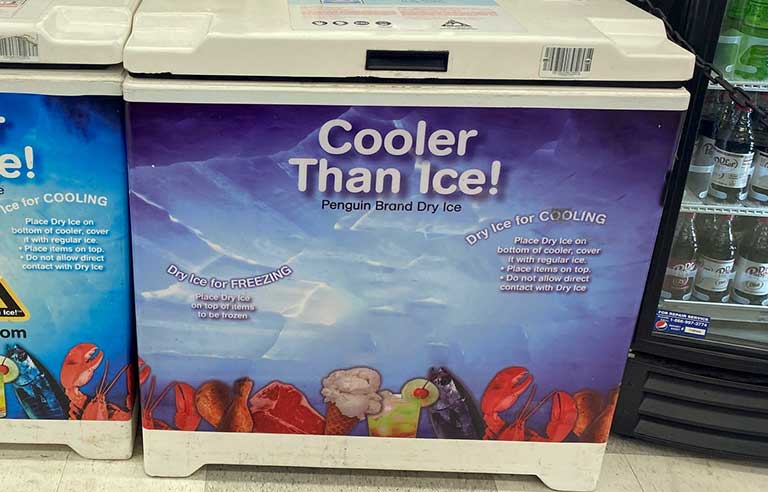
If you’ve ever ordered or received a gift of meat, ice cream or other perishable food from an online company, it may have been shipped with dry ice.
“Dry ice is frozen carbon dioxide,” the National Weather Service says.
“Unlike most solids, it does not melt into a liquid, but instead changes
directly into a gas.”
Dry ice is very different from regular ice – its temperature is around -109° F, and it needs to be handled carefully to prevent injuries. The NWS says to:
- Never put dry ice in your mouth or swallow it! If you do, get medical
help immediately. - Don’t touch dry ice with your bare skin – it can cause severe
frostbite. Use tongs, thick gloves or an oven mitt. - Never place dry ice in an unventilated room or car – the carbon
dioxide can build up and cause unconsciousness and even death. - Never place dry ice in an airtight container. As it turns from a solid
into a gas, the gas can build up until the container bursts. Use a foam
cooler with a loose-fitting lid. - Don’t store dry ice in your freezer – it could cause the freezer to become
too cold and the motor to shut off. When your dry ice is no longer
needed, place it in a well-ventilated container and take it outside where
kids and pets can’t reach it. It’ll turn into gas and disappear.