

How would you describe the current job market for safety professionals?
Are you thinking about changing jobs?
What are some current or emerging issues safety and health pros need to keep tabs on?
What can employers do to encourage safety pros to stay at their jobs longer?
These were some of the questions included in our 2023 Job Outlook survey, sent out in March.
Here, we’ve got the results, as well as the “You said it” section featuring comments from safety pros. Thanks to everyone who responded.
Got thoughts? Submit your own comment.
What’s the Job Outlook for safety professionals?
Check out the 2023 survey results
 About the respondents |
 Your take: Survey results |
 Comments on safety pro retention |
| NEXT About the respondents |
> |
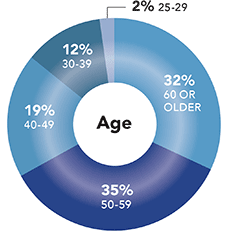
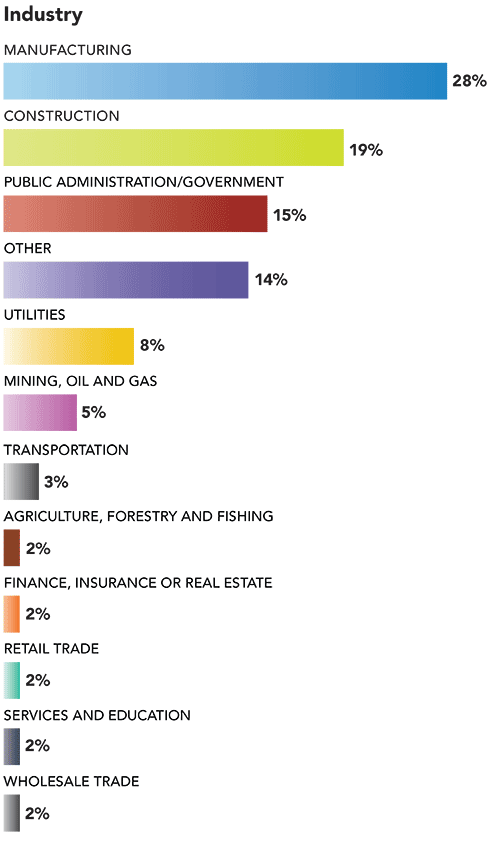
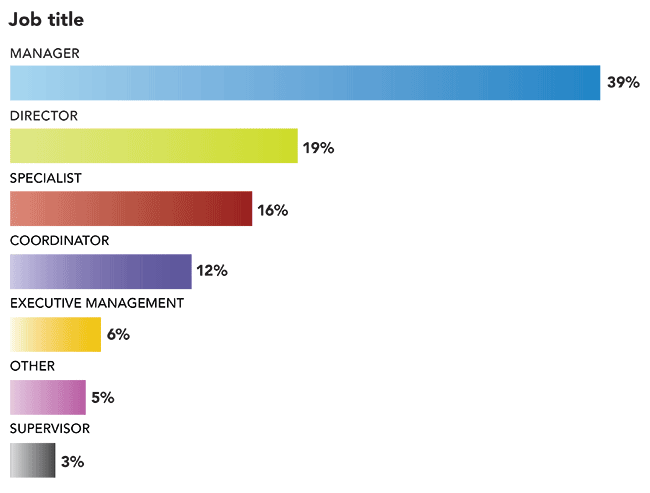
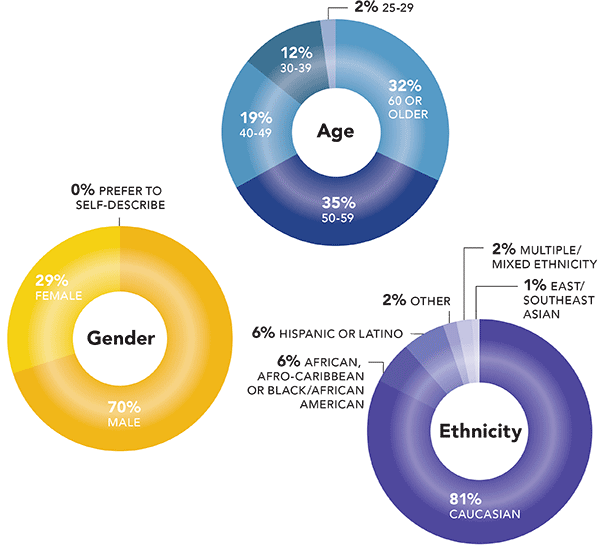
About the respondents
| NEXT Your take: Results of the survey |
> |
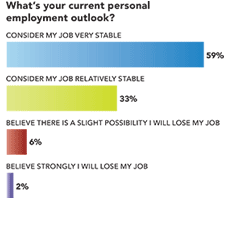
Your take: Results of Safety+Health’s 2023 Job Outlook survey
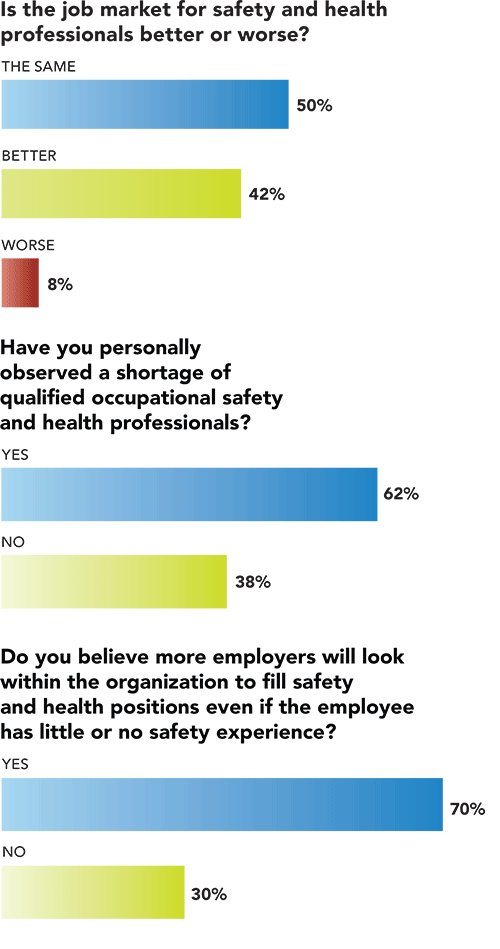
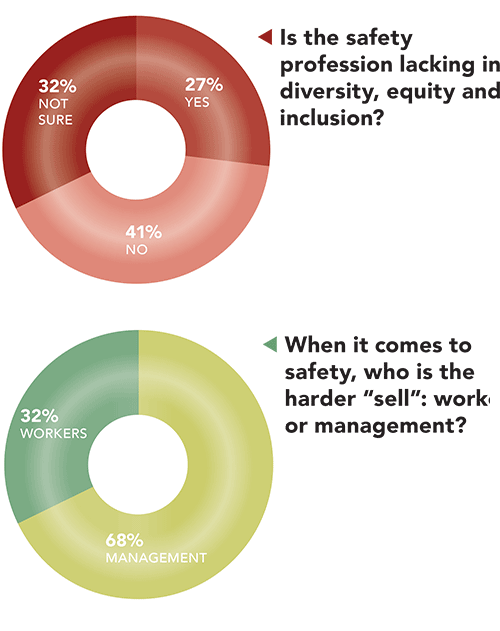
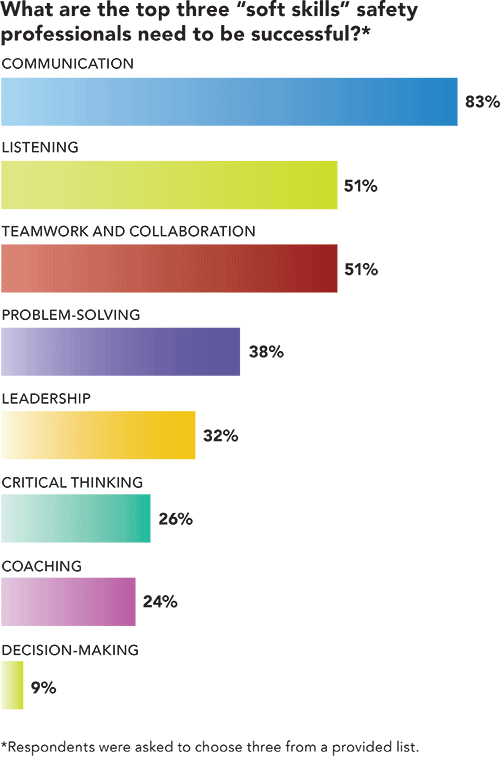
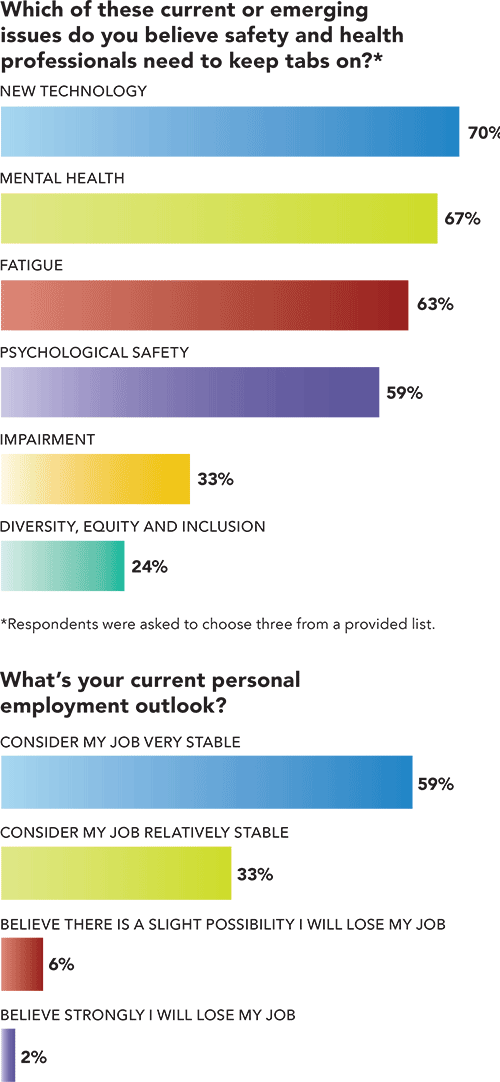
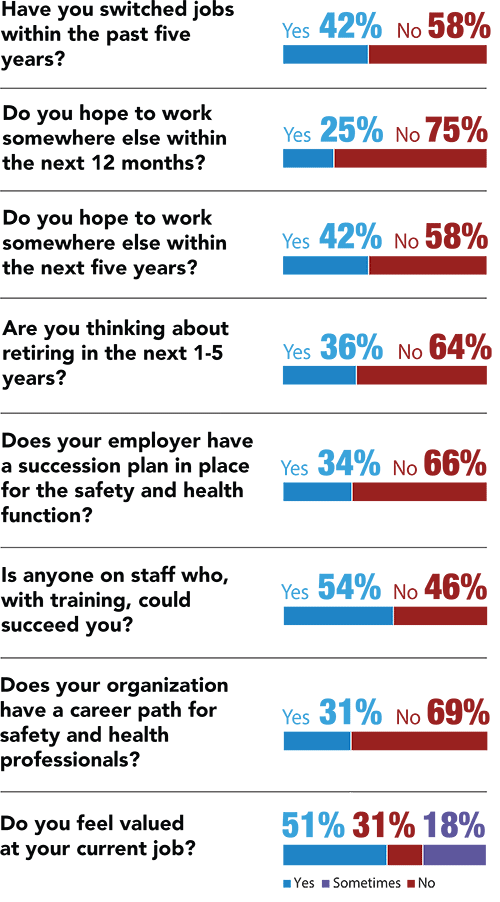
Note: Percentages may not add up to 100 because of rounding.
The Safety+Health 2023 Job Outlook survey was emailed
in March to 11,423 S+H subscribers; 223 responded for a 2% response rate.
| NEXT You said it: How to retain safety pros |
> |
You said it
Respondents had a lot to say when we asked, “What can employers do to encourage safety professionals to stay at their jobs longer?” Here are five common responses, along with some of the comments.
Offer better pay and benefits
$$$$$$
Raises, raises, raises.
Good salaries and benefits go a long way.
Incentives and paying safety professionals what they are worth in the beginning. Saw one company was looking for a safety professional for $26/hr. Good luck with that.
Better compensation for their role. We are losing staff to better paying jobs in similar industries.
Reward experience and perseverance. What we do is often a very thankless profession, with major liability that most never consider.
Pay increases commensurate with skills and education and licensing obtained
Pay them for their knowledge, performance and skill sets.
With the current market trends with younger workers and the lack of organizations to change their benefits packages to entice workers to stay, the short term job-hopping will continue.
Support and invest in safety
Management support. People will leave if their input is not valued or acted upon.
Commitment from leadership (managers and supervisors) to allow safety to be an important part of their culture.
Management needs to realize that EHS can’t do much without their full support and assistance.
Support them! Most companies really don’t support health and safety, they just have it because it makes the company look good overall.
Safety and health professionals must be empowered by upper management. Organizations need to realize that at times it requires safety professionals to start from scratch with certain procedures instead of checking the box for effectiveness of the procedures.
Recognition of the importance of safety from the top down, rather than “butting heads” with the safety team when things need to change. Production and safety are not at odds.
Management buy-in and ownership of responsibility – make a commitment to learn, understand, and apply safety regulations and concepts so that the safety department isn’t constantly re-explaining practices that should have already become a vital part of the company culture if management understood and supported them.
Provide them with the authority and the support to make organizational changes in the safety programming. Allow for new ideas to be heard and come to fruition as the industry changes and grows.
Investments in equipment and resources – technology
Encourage management systems to value safety above profits and really make that change.
Ensure the H&S is not a team of one, and the organization supports this position – or, better yet, positions. Oftentimes, it is a “one-man show.” I have learned to rely upon specific individuals within each department, which can still be challenging.
Do more to improve management culture as a whole. Managers are allowed to act poorly toward others and behave unprofessionally toward HSE.
Support them in continuing education and, most importantly, by leading by example and being genuinely engaged in creating a world-class culture, not just mere compliance or checking a box.
Management needs to demonstrate the EHS is an integral part of the business.
Understand that environmental, sustainability, recycling are important factors for younger generations – brand and environmental stewardship
Make safety pros feel valued/respected
They must be valued as part of the leadership team. If they don’t have that, why stay?
Treat them with respect and listen to what they say.
Employers must show the safety professional that they add value to the organization and that they are appreciated.
Safety should be recognized and respected by all divisions within the company. Safety can be a thankless job, and having to fight to implement a safety program and culture is discouraging.
As an organization, show that you respect the knowledge and experience that seasoned veterans can bring to the organization.
Treat them right and get the whole company on board. Safety professionals don’t own safety.
Acknowledge their value to their organization.
Create a true EHS department and not utilize people to conduct safety as an added role or responsibility.
S&H professionals need to be listened to and valued as an important business partner.
Show appreciation for the work they are doing. So often, I have to “teach” executive leaders to understand what the HSE professional does and the value they bring to the organization.
More respect and empowerment toward the professional. EHS professionals would stay longer if their opinions are heard and safety is priority in all levels of organizations. Unfortunately, the market is not filled with companies like that.
Hold them in a higher regard and keep them on the same career path as operations. Don’t downgrade your safety professionals because you can’t measure their value or the money they bring into or save the company.
Like any employee, safety and health professionals need to feel valued. Perhaps more than other professionals, safety and health professionals would stay longer in positions or have more loyalty to a business if their safety and health initiatives/ideas/programs were taken more seriously by their organizations and workforce. Of course this does not fall solely on the organization, but I’ve seen quality programs and people be turned away for reasons that do not reflect an organization’s stated dedication to safety.
The key stakeholders within the organization need to build a value for their safety program and their safety professionals. Both should be an integral part of daily business and business decisions, as it is an equal partnership for a successful organization.
Provide opportunities for training, development and advancement
Provide safety and health professionals with the opportunity for advancement. There is often no room to grow, especially in smaller businesses.
Train and develop your employees. 75% of those that left my company voluntarily had had little to no training or development.
Encourage professional development to keep the information fresh.
A career path would be beneficial.
Become more diverse, provide mentorship program. Be inclusive.
Offer training opportunities to maintain and obtain credentials and other educational opportunities. Offer opportunities to work on forums, committees, etc., to create new safety process/programs/etc. Offer opportunities to cross-train other safety professionals within the organization.
Succession plans. Most of the time safety coordinators and safety managers have to leave the company in order to take the next step. Companies of a certain size should have multiple levels – coordinator, manager, director, VP. If they don’t have something like that, you can’t expect a safety professional to stick around longer than four or five years at most.
Offer a better work-life balance
Respect work-life balance. We can’t do more with less exponentially – people have limits.
Stop overloading the staff; where multiple employees used to handle the load, now only one does. It is leading to burnout.
Additional H&S and support staff so we don’t get burned out feeling like we have to do it all by ourselves.
Not overwork them. Labor pool has decreased and the quality of workers has declined as well.
Fewer hours worked, less projects to oversee so nothing gets overlooked, allotting more time for proper training of employees – new and experienced.
Jobsite safety is far too important to require the onsite safety personnel to perform all jobsite tasks as well as manage all the associated paperwork. There should be one individual (possibly in the headquarters office) who requests info from the subcontractors, ensures it is received, filed where readily available to all parties, follows up on missing info, maintains the records. Depending upon the number of subcontractors, this may be a full-time position during new project startup.
Part-time work for those looking to retire. It may keep them working and passing more knowledge on without the full-time commitment and pace of today’s workload for EHS professionals.
Have something you want to share? Add to the conversation by submitting a comment.

