


As a safety professional, you’re in a unique position in your organization. At times, you’re communicating with frontline workers via toolbox talks. Other times, you’re explaining the return on investment of safety to people in the C-suite. Altogether, your words can have an impact on many levels.
However, presenting can cause a fair amount of butterflies – no matter the audience or how long you’ve been in the profession.
Communications consultant John Capecci shared tips and advice for safety professionals on how to become a better public speaker during a recent episode of “On the Safe Side,” Safety+Health’s podcast.
“I would guess that most safety professionals probably didn’t choose this career because it would give you a lot of opportunities to speak, but it’s an important part of the career and of life,” communications consultant and coach John Capecci said during a recent episode of Safety+Health’s podcast, “On the Safe Side.” “When you’re responsible for delivering a message – whether that’s to inform or persuade an audience – that’s a lot of responsibility. We feel that as speakers.”
Strengthening your public speaking skills can help relieve some of that anxiety. It can also lead to “personal grati-fication when you’ve made a connection,” Capecci said.
“When you see heads nod or eyebrows rise,” he added. “When they ask questions. There’s nothing like knowing you’ve made a difference.”
Effective speakers are building their personal and professional ethos and will find that their impact will mean more speaking opportunities.
“Don’t be surprised when you start getting more requests,” he said.
So, how can you train and flex your public speaking muscles?
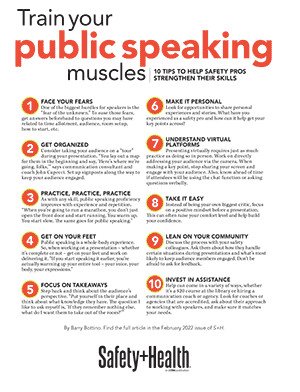
Here are 10 tips from Capecci to polish your skills and build confidence:
Face your fears
One of the biggest hurdles for speakers is the “fear of the unknown.” To ease those fears, get answers before-hand to questions you may have related to time allotment, audience, room setup, how to start, etc.
Get organized
Consider taking your audience on a “tour” during your presentation. “You lay out a map for them in the begin-ning and say, ‘Here’s where we’re going, folks.’” Set up signposts along the way to keep your audience engaged.
Practice, practice, practice
As with any skill, public speaking proficiency improves with experience and repetition. “When you’re going to run a marathon, you don’t just open the front door and start running. You warm up. You start slow. The same goes for public speaking.”
Get on your feet
Public speaking is a whole-body experience. So, when working on a presentation – whether it’s complete or not – get on your feet and work on delivering it. “If you start speaking it earlier, you’re actually warming up your entire tool – your voice, your body, your expressions.”
Focus on takeaways
Step back and think about the audience’s perspective. “Put yourself in their place and think about what knowledge they have. The question I like to ask myself is, ‘If they remember nothing else, what do I want them to take out of the room?’”
Read tips 6 through 10 on page 2
Page 2 of 2
Read tips 1 through 5 on page 1
Make it personal
Look for opportunities to share personal experiences and stories. What have you experienced as a safety pro and how can it help get your key points across?
Understand virtual platforms
Presenting virtually requires just as much practice as doing so in person. Work on directly addressing your audience via the camera. When making a key point, stop sharing your screen and engage with your audience. Also, know ahead of time if attendees will be using the chat function or asking questions verbally.
Take it easy
Instead of being your own biggest critic, focus on a positive mindset before a presentation. This can often raise your comfort level and help build your confidence.
Lean on your community
Discuss the process with your safety colleagues. Ask them about how they handle certain situations during presenta-tions and what’s most likely to keep audience members engaged. Don’t be afraid to ask for feedback.
Invest in assistance
Help can come in a variety of ways, whether it’s a $20 course at the library or hiring a communication coach or agency. Look for coaches or agencies that are accredited, ask about their approach to working with speakers, and make sure it matches your needs.

