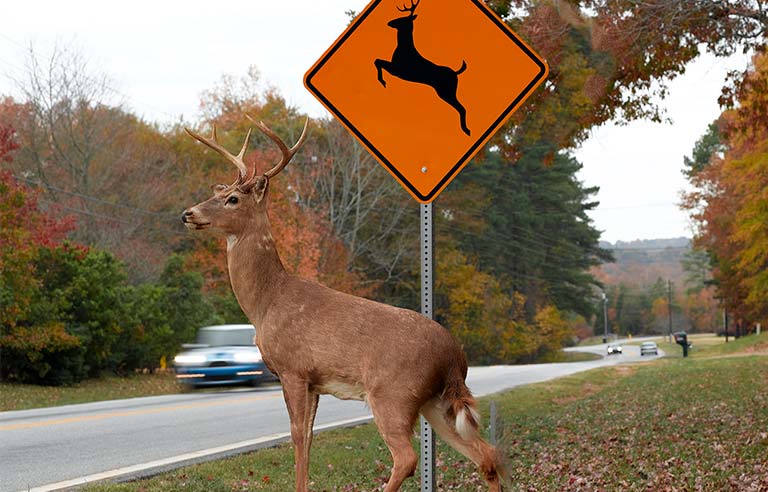
On your early morning drive to work, a deer pokes its head out from the trees along the roadside. The actions you take next will determine not only your own safety, but that of the animal and possibly other motorists.
Around 1.5 million deer-vehicle collisions occur each year on the nation’s roadways, estimates the Humane Society of the United States. How can you avoid becoming part of that statistic?
“The easiest way to avoid a collision is to not be distracted or impaired while driving,” Michigan State Police Sgt. Kim Vetter says. “That means paying attention to the roadway, keeping your eyes on the road, and not being distracted by devices in the car or other occupants.”
Here’s what else you should know about encountering deer while driving.
Activity tracker
Although some are on the move at night, deer are most active at dawn and dusk, says Moriah Boggess, a deer biologist with the Indiana Department of Natural Resources Division of Fish and Wildlife.
“They’re getting up for the day and they’re settling in for the night,” Boggess said. When it comes to collisions, however, the most dangerous time on the road is during the deer breeding season, commonly known as “the rut.”
“They are moving around a lot more at that time of year,” Boggess said, “so much so that scientists can use that collision rate to determine when deer breeding is occurring in an area.”
The timing varies by region. In the Midwest and along the East Coast, breeding takes place from mid-October through the end of November. “Down in Florida, deer are breeding in late July or August, and all the way until February in Alabama and some parts of Mississippi,” Boggess said.
Do you know the peak times of deer breeding in your area? The website of your state’s department of natural resources or fish and wildlife agency is a great resource.
Roaming together
If you see a deer near the road, more are likely to follow. Deer don’t travel alone.
“Oftentimes, a motorist will hit a deer after they’ve seen another,” he said. “Deer are often confused. They don’t necessarily understand the direction of travel or what’s happening on that road. They’re prone to quick movements and maybe running in a new direction because they’re frightened.”
A common scenario during the breeding season is when a female, known as a doe, crosses a road and is followed by a buck. When you get behind the wheel, Vetter wants you to remember: “Deer live here all the time, and they move all the time.”
Watch your speed
Speed is a major factor in deer-vehicle collisions. When you’re driving during peak movement times of the day or season, slow down.
“Taking speed out of the equation helps decrease the impact of a crash,” Vetter said. “If you slow and still strike the deer, hopefully it does less damage to both the deer and the car.”
Boggess said driving slower also increases your reaction and braking time.
“You’ll be a lot safer at a slower speed,” he said. “It also gives the deer more time to detect you and your direction of travel if you’re going slower.”
Steer or swerve?
When it comes to the decision – often made in a split second – to steer or swerve to avoid hitting a deer, one option is much safer than the other: steering.
In her experience patrolling Michigan’s roadways, Vetter has found that more fatalities occur when drivers swerve off the road.
“We recommend people do not swerve,” she said. “That’s where we see the most fatalities, when somebody leaves the roadway and overturns or strikes another object, like a tree, a fence, a guardrail or another vehicle. That’s where we see the most damage.”
Vetter’s advice? “Steer through the collision. The deer will move and might not survive, unfortunately. If you swerve and hit a tree, the tree doesn’t move.”
If you do strike a deer, Vetter says to stay in your vehicle and call 911. This will help keep you safe from passing vehicles.
Don’t approach an injured deer. “They can be unpredictable, especially when they’re injured,” she said. “They can charge. They can cause a lot of injury if they attack.”
Myths debunked
You may have heard that honking your horn, flashing your lights or using deer whistles attached to your front bumper will help deter deer from running onto the road. Boggess and Vetter agree that none of those is a trusted method.
Flashing lights may cause deer to stop in the road. “We’ve all heard the saying, ‘a deer in the headlights,’” Boggess said. “That frozen stare.”
Noise from your car horn or a whistle will startle a deer, and Vetter said that could cause the animal to dart across the road rather than back into the woods. “There’s no way to predict what they’re going to do,” she said.
Boggess said the most promising research focuses on the use of rear-facing LED bars, which light up the entire front of your vehicle during low-light conditions, making it more visible to deer. In July 2020, the U.S. Department of Agriculture’s Wildlife Services program announced it had applied for a patent for the device after completing a study.
The device can be used in addition to headlights, which deer often don’t see well.
“They see shining bright lights, but they’re just small dots that they see,” Boggess said. “Light bars are lighting up the entire front of your vehicle so it can be seen by the deer as an object coming toward them.”