The summer sun is one of the things that make trips to the beach, cookouts and other outdoor activities so special.
The downside: Exposure to the sun’s ultraviolet rays can lead to skin damage, cancer and other health problems.
But by taking some simple steps, you can stay safe while enjoying your fun in the sun.
Time of day
Although it might be tough, try to limit your time in the sun between 10 a.m. and 4 p.m. That’s when the sun’s damaging UV rays are the strongest.
You don’t necessarily have to stay indoors, but when you go outside, seek shade under an umbrella, a tree or other large object whenever you can during those peak sun hours.
Take extra care if you’re near water and sand because they can reflect the sun’s rays.
Sunscreen
Invented nearly a century ago, sunscreen is key to helping you avoid health problems related to UV exposure such as melanoma – the deadliest form of skin cancer. When applied to your skin, sunscreen serves as a layer of protection against the sun’s harmful UV rays.
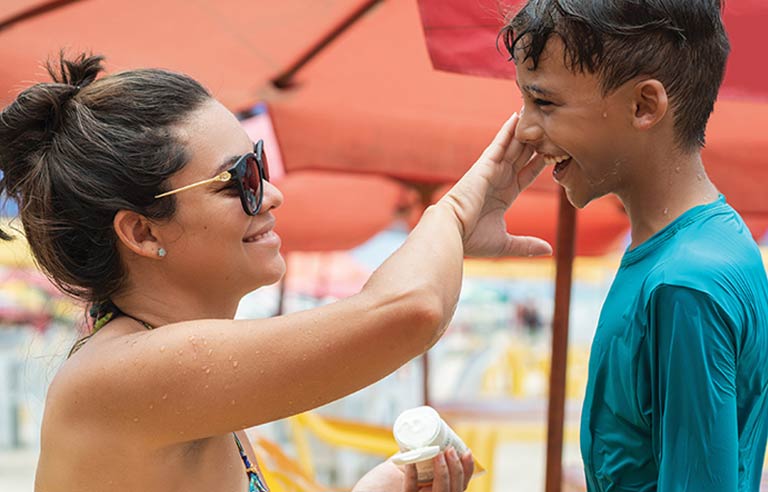
The Environmental Protection Agency says you should cover all exposed skin with sunscreen about 15 minutes before heading outside. Then, reapply it every two hours – even on cloudy days – or immediately after being in water. You should reapply more often when you’re sweating or exercising. That’s because “water resistant” sunscreen isn’t waterproof, according to the American Cancer Society.
How much do you need? More than you probably think. The Food and Drug Administration says that “an average-sized adult or child needs at least one ounce of sunscreen (about the amount it takes to fill a shot glass) to evenly cover the body from head to toe.”
The key number to look for on your bottle of sunscreen is the sun protection factor. A sunscreen product with an SPF of 15 filters out about 93% of UVB rays, the ACS says, while an SPF 30 sunscreen will filter out around 97%.
“No sunscreen protects you completely,” says the ACS, which recommends you use products labeled “broad spectrum” to shield against both UVA and UVB rays.
The ACS adds that the FDA requires any sunscreen with an SPF below 15 to carry a warning that it only protects against sunburn and not skin cancer or any other skin damage.
Did you know sunscreen has an expiration date? Check the date on your bottle before applying.
The ACS also suggests giving your sunscreen bottle a shake to remix the ingredients if you haven’t used it in a while. Storage matters, too: Keeping your bottle in a hot place such as your car’s glove compartment may cause it to lose some of its effectiveness.
Sunglasses
Wearing sunglasses outside not only can protect your eyes from UV rays but also can reduce your risk of developing cataracts, according to the Centers for Disease Control and Prevention. Look for sunglasses that block both UVA and UVB rays. The good news: Most sunglasses sold in the United States – even the least expensive ones – typically do. Check for a label that reads “UV absorption up to 400 nm” or “Meets ANSI UV requirements,” the ACS says.
“Those labeled ‘cosmetic’ block about 70% of UV rays,” the society’s website states. “If there is no label, don’t assume the sunglasses provide any UV protection.”
The FDA says many light-tinted glasses (green, amber, red and gray) can protect your eyes just as well as dark-tinted ones. Wraparound sunglasses work the best because they block UV rays from the sides of your face.
Hats and other protective clothing
Sunglasses are most effective when paired with sunscreen and a wide-brim hat, according to the FDA. Ideally, the brim should be about 2 to 3 inches around the hat. This will help protect your ears, forehead, nose and scalp. Dark, nonreflective material on the underside of the brim can lessen the UV rays reaching your face from reflective surfaces such as water or sand.
If you like wearing caps, use one that has a sun shield – a covering that drapes over the neck/eyes – for extra protection. Wear long-sleeved shirts, pants or skirts when possible to protect against the sun’s rays. If that’s not practical, even a T-shirt or beach cover-up (when paired with sunscreen) will help.
Protecting kids
Infants younger than 6 months old should be kept out of direct sunlight, the American Academy of Pediatrics says. And when they’re outdoors, they should be dressed in lightweight, long pants; a long-sleeved shirt; and a brimmed hat. If any areas of their skin are exposed, such as the face and back of the hands, apply an SPF 15 sunscreen.
As with adults, children should put sunscreen on about 15 minutes before going outdoors, but be careful when applying it around their eyes. Kids also should wear sunglasses with UV protection. Choose carefully: The FDA warns that toy sunglasses may not provide adequate protection. Once again, check for a UV protection label and find a pair that fits your child well.
“Children need special attention,” the ACS says. “They tend to spend more time outdoors, can burn more easily and may not be aware of the dangers. Parents and other caregivers should protect children from excess sun exposure.”