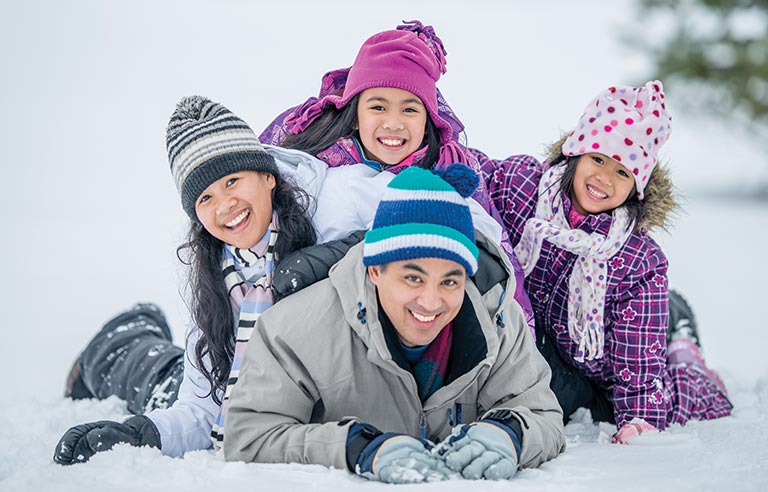
Sledding, ice skating and playing in the snow aren’t just fun – they’re good exercise and a great reason to head outdoors during the winter. But remember: Safety first.
Ready? Get started by following some expert advice.
Layer up
The American Academy of Pediatrics says parents and caregivers should dress kids in several thin layers before taking them outside. This keeps them dry and warm, and reduces the risk of frostbite and hypothermia. Boots, gloves or mittens, and a winter hat are musts.
Lois Lee, a pediatric emergency medicine physician at Boston Children’s Hospital and president of the Injury Free Coalition for Kids, says a rule of thumb is to dress kids in one layer more than what an adult would wear under similar weather conditions.
“Layering is also important because if they’re playing outside, they may start to feel warm, and so they can take off a layer if they need to,” Lee said.
Here comes the sun
Although removing a layer can help keep you from feeling too warm, it also can increase your exposure to the sun – which can get even more intense when its rays reflect off snow.
Brooks Jordan, an experienced parks and recreation professional and a district manager for Wyoming State Parks, says it’s common for winter outdoor fun-seekers to forget about applying sunscreen to exposed skin. Sunscreen provides equal protection in the winter months – even if you’re squeezing some from the tube that’s been lying around since summer.
“It’s better to use what you have than nothing at all,” Jordan said.
Safe sledding
Heading for a sled or toboggan hill? The National Safety Council offers tips:
- Make sure all equipment is free of sharp edges and cracks, and that sledders are wearing helmets.
- Sled on spacious, gently sloping hills with a level runoff at the bottom to allow for safe speeds and stopping.
- Check sledding areas for bare spots, holes and obstructions such as rocks and trees.
- Don’t sled on or near frozen bodies of water.
- When riding, sit or lay on your back on top of the sled with your feet pointing downhill. Never sled headfirst.
Adults should supervise sledding groups, making sure sledders take turns if a hill or area becomes crowded.
Safe skating
Some cities and park districts set up outdoor skate rinks in the winter, and take steps to make sure they’re safe. But if you’re thinking about heading to a local pond or lake, you may want to reconsider. Fluctuations in wintertime temperatures can make activities on frozen bodies of water a precarious proposition. Where one area of ice might be thick enough to support weight, another patch nearby might be much thinner.
The American Academy of Pediatrics advises skating only on approved surfaces. Look for signs posted by local police or recreation departments, or contact police or park authorities to confirm which areas are safe for skating. Once you’re on the ice, the AAP recommends:
- Skating in the same direction as others.
- Refraining from darting across the ice.
- Skating in a group, not alone.
- Avoiding chewing gum or eating. “It’s good to minimize the distractions that may be going on while skating,” Jordan said. “Those tend to lead to more on-ice collisions and falls.”
Jordan also stresses the importance of being honest about your ability and physical condition before skating – especially for adults. When was the last time you skated? Is your strength and balance not what it used to be? If skates or other equipment are being provided, how do they compare with what you’re used to?
Jordan recommends wearing a helmet and gloves while skating, and considering sunglasses if you’ll be skating outdoors on a bright day.
About time
Sometimes kids have so much fun playing outdoors that they don’t want to come inside. Set boundaries beforehand, explaining to kids that the colder the temperature, the greater the need to take breaks inside.
“Say, ‘We’re going to go outside and play, but in 30 minutes, we’re going to come inside and drink something warm,’ so that way, the children have that expectation that they will be coming in to warm up but then they can go back outside,” Lee said.
If you’re heading to a location farther from home, such as a park, have a plan for finding warmth, “whether that be in a vehicle or a warming station, or identifying a home nearby or other place where people can warm up,” Jordan said.
Avoid emergencies
Whether you’ll be visiting a recreation area or staying on your own block, Capt. John Mehling of the Fishers (IN) Fire Department wants you to remember to stay away from snowblowers and snowplows.
Don’t walk in the street, even if sidewalks are covered with snow, and use extra caution if crossing the road.
If you’re near a body of water and you see a person or a pet fall through thin ice, contact authorities immediately. Don’t attempt a rescue yourself, as this accelerates your risk of falling into the icy water.
“The sooner you get 911 called and get rescuers on the way, the faster that’s going to have a happier outcome,” Mehling said.