
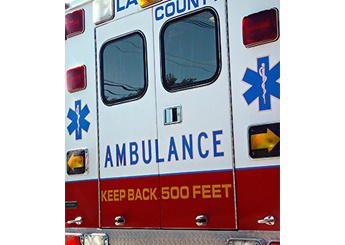
Gaithersburg, MD – A four-year effort on the part of researchers has led to recent safety improvements for emergency responders and an updated standard for ambulance design.
The National Institute of Standards and Technology and two federal partners collaborated on the project, which prompted new guidelines for the patient compartments of ambulances. The federal agencies that helped with the project were NIOSH and the Department of Homeland Security Science and Technology Directorate.
The guidelines include recommendations for seat positioning, restraints, equipment mounting, ventilation, interior surfaces and storage, and other items. The National Fire Protection Association used the information to revise NFPA 1917, Standard for Automotive Ambulances.
According to the National Highway Traffic Safety Administration, an average of 4,500 vehicle crashes involving ambulances occurred every year between 1992 and 2011. About one-third of those crashes resulted in injuries.
A deeper analysis of the crash statistics revealed that 84 percent of emergency responders in the patient compartment were not restrained, and 33 percent of patients were secured with shoulder restraints as well as lap restraints.

