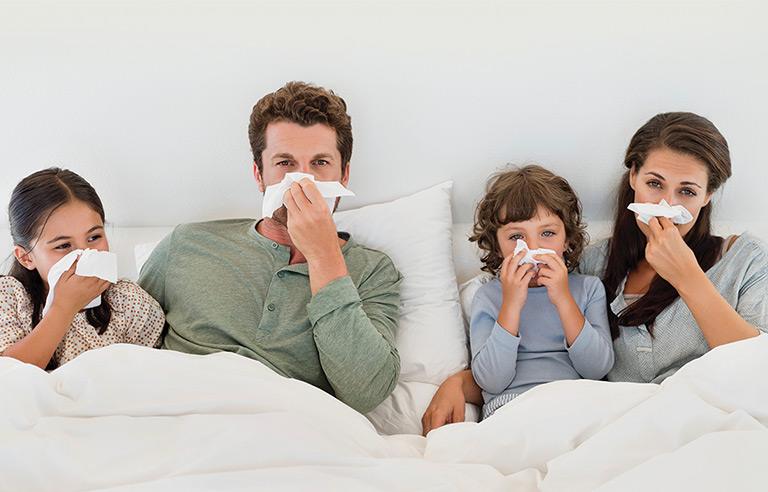
When someone at home isn’t feeling well but you’ve made plans, it can be hard to know what to do!
Whether it’s at work or school, sporting events, or get-togethers with friends or family, whenever people gather, germs can spread. Should all plans automatically be canceled, or does it depend on the symptoms or illness?
We asked David L. Hill, a physician and adjunct associate professor of pediatrics at the University of North Carolina School of Medicine, for advice.
Upon closer exam
What’s the first thing you should do if you or a family member isn’t feeling good? “The same thing I would do as a doctor,” Hill said. “Take a history and get a physical exam.” That includes:
- How the person looks. (Do they look ill?)
- How the skin feels. (Is it hot or clammy?)
- Skin color. (Is it normal or pale?)
- Breathing. (Is it irregular?)
- Behavior. (Are they usually more alert or active?)
If it’s a child who’s feeling sick and they’re old enough to describe it to you, ask them to tell you what they’re feeling, Hill recommends.
Otherwise, use your best judgment based on everything you know about your child’s typical behavior.
As Hill says, “You’re the world’s top expert in your child’s well-being.”
Be honest
Getting sick can interfere with your plans, and backing out may make you feel guilty. But remember, you’re doing it for a good reason: You don’t want to get anyone else sick.
Hill’s advice: “Personally, I’m a huge fan of honesty. There’s nothing wrong in saying that you want your child to be well for school, for an upcoming activity or simply because you have a very busy family schedule.
“Offer to reschedule or to host next time as a show of good faith.”
What if the symptoms are just starting?
“When symptoms are mild, I think it’s absolutely fine to see how they progress,” Hill said. “A little nausea, a headache or a runny nose may all be quite temporary.”
However, he noted, “A fever of 100° F or more, diarrhea, or a real cough deserve at least 24 hours of observation to see if they develop into something more persistent.”
Wash those hands
As for keeping any sickness out of your home in the first place, although not foolproof: “It’s hard to beat appropriate handwashing,” Hill said. “Especially during the colder months, family members should wash their hands when they get home and, of course, always after using the bathroom.”
Another piece of advice: Teach kids to cough into their elbows and model the action yourself. This helps cut down on the spread of disease.
Common illnesses (and precautions to take)
Even when you’re being mindful about preventing the spread of illness, it can be a challenge to determine which symptoms and conditions should be considered more serious than others. We asked Hill for general advice on the severity of some common illnesses and what to do if someone isn’t feeling well.
Check out his advice in the table below.
For conditions such as a headache or rash, Hill said it’s too difficult to cite one specific action to take. Use your best judgment based on how you or the person is feeling.
For unsure parents and caregivers, “If you have any questions or concerns, always call your child’s doctor,” he said. “That’s what we’re there for.”
| Symptoms/illnesses | What you should do |
|---|---|
| Sniffles |
If you don’t have a fever and you otherwise feel well, go about your day, but remember to practice good hygiene.
|
| Cough |
As a general rule, it’s normal for a cough to last up to three weeks. For a child with one, remind them to cough into their elbow or a tissue. If the coughing includes chest pain, wheezing or shortness of breath, schedule a visit with your health care provider.
|
| A cold |
If you don’t have a fever and you otherwise feel well, you’re OK to go on with your plans. Remember to practice good handwashing habits and cough/sneeze etiquette.
|
| Bronchitis |
“In the world of pediatrics,” Hill said, “bronchitis is another name for a viral cold, so the same guidelines apply.”
|
| Fever |
A fever should be gone for 24 hours – without the help of a fever reducer – before you return to regular activities.
|
| Stomachache |
Hill says “there’s too broad a range to make a blanket statement” about staying home with a stomachache, but “if they won’t be able to participate in activities, then they should be home until they feel better.
|
| Sore throat |
If a sore throat is accompanied by a fever, it’s a good idea to visit a medical provider to get tested for strep throat, which can be contagious. If the sore throat presents as part of a cold (runny nose, cough, no fever), “then it’s a matter of how bad the cold is.”
|
| Influenza |
No activity until you’ve gone without a fever for 24 hours.
|
| COVID-19 |
Stay home for at least five days after a positive diagnosis.
|
| Conjunctivitis/pink eye |
The American Academy of Pediatrics doesn’t support isolating kids who have pink eye. “The most common form is viral and will resolve on its own,” Hill said. “The rarer bacterial forms are much less contagious.” Your health care provider may write a prescription for antibiotic eye drops for the bacterial infection.
|
| Norovirus |
Hill said “this is among the most contagious stomach bugs out there.” Stay home until the diarrhea has ended. Don’t forget to wash your hands every time you use the bathroom.
|
| Whooping cough |
If diagnosed, you should be on antibiotics for at least five days before leaving home. “Additionally,” Hill said, “all exposed household members should receive an antibiotic within 21 days.”
|
| Croup |
Your child should be able to resume normal activities within a couple of days.
|
| Respiratory syncytial virus (RSV) |
For kids older than 2, RSV usually resembles the common cold. For kids younger than 2, however, it can lead to symptoms that may be severe enough to require hospitalization. Consult your child’s pediatrician if RSV is suspected.
|
| Hand, foot and mouth disease |
Kids with HFMD can be infectious for weeks – even after symptoms resolve – so it’s not practical to keep them home once they feel well enough to return to their regular schedule. The most important thing, Hill said, is to make sure they’re well-hydrated. This can be difficult when mouth sores caused by the disease make it hard to eat and drink.
|
| Chickenpox |
Stay away from other people until all the lesions have crusted over.
|
| Mononucleosis (Mono) |
Mononucleosis is commonly referred to as “the kissing disease,” but it can also be spread if you share a water bottle or eating utensils with another person. Mono also may be passed on weeks to months after symptoms are gone, as the recovery phase can last for up to six months. Hill said you can resume activities as soon as you feel better, except in cases in which the spleen becomes enlarged. If you experience this side effect of mono, don’t take part in contact sports until a health care provider gives you the OK to return.
|