
Baltimore — All workers can be leaders by taking daily action and accountability to develop an environment “that builds and creates trust and safety.”
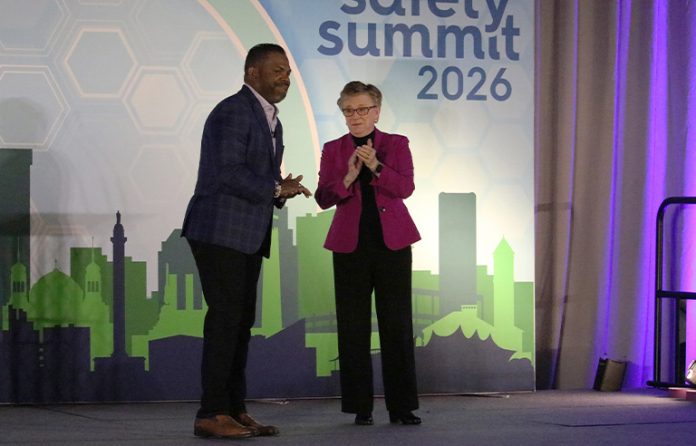
Retired U.S. Air Force Lt. Col. Jason O. Harris offered that perspective May 7 during the Opening Session of the 2026 NSC Safety Summit.
Frequently calling on attendees at the Baltimore Convention Center to recall the paths they’ve followed in their professional lives, Harris stressed that listening, understanding and acknowledgment are keys to growing trust within organizations.
“But it’s not enough,” he said, “until you take action.”
NSC CEO Lorraine M. Martin agreed.
“At NSC, we believe that organizational culture built on trust must start on the first day, whatever that means for that employee,” Martin said in her introductory remarks. “Reinforced by robust training, practical education, and the tools that people need to recognize risk and work safely from the start – not from the start of the first incident.”
As did Martin, session emcee Bryce Griffler, co-founder of consulting and training firm Safety is for Everyone, addressed a growing challenge safety professionals face as they cultivate a culture of trust: artificial intelligence.
Griffler discussed how AI and other emerging technologies have made the world “simply too complex” to operate in a binary, yes-or-no manner.
“In order to be resilient and thrive in this multifaceted world,” Griffler said, “we have to embrace the power of the word ‘and.’ … The type of ‘and’ that embraces more than one model, more than one approach, more than one mindset to help solve big challenges.”
Organizations often turn to technology to help close experience gaps and manage risk as work becomes more complex, Martin said.
Although technology is “absolutely transforming” ventures such as risk identification and hazard prediction by finding patterns to allow for early intervention, organizations can’t become fully reliant on it, she added.
“When paired with transparency and employee buy-in, technology can become an extremely powerful complement to human judgment,” Martin said, “helping us to really focus on where those consequences are greatest and preventing the most serious harm.”
Harris, a guest on the April episode of the “On the Safe Side” podcast, cited his past experiences as a military pilot in exploring how trust influences the entire work experience.
Crews of the C-130J aircraft he operated had to trust the loadmasters – many of whom were recent high school graduates – to properly check and load aircraft, then assist from the back of the plane during flight.
“They were able to see our blind spots at some of the most critical times,” Harris said. “For each and every one of your organizations, who are those people that are operating on the front lines that can see the things that you can’t see? … We have to have loadmasters in our lives to help us get through the challenging times.
“And not only in the airplane, not only in the job, but in our personal lives.”
NSC co-located multiple events under the Safety Summit, which runs through May 8:
- Future of EHS Conference
- Human & Organizational Performance (HOP) Summit
- NSC Spring Safety Conference & Expo
- Safety on the Edge Conference

