

San Francisco — Employers at poultry- and pork-processing plants can help reduce musculoskeletal injuries by providing care beyond first aid and encouraging workers to report symptoms early, a University of California researcher contends.
Speaking during a recent webinar hosted by the Center for Occupational and Environmental Health at UC Berkeley, Carisa Harris discussed the results of a pair of studies from the U.S. Department of Agriculture’s Food Safety Inspection Service for which she was co-principal investigator.
An assistant professor in the UC San Francisco Department of Medicine and UC Berkeley School of Public Health, Harris and others examined the effects of increased line speeds on worker safety.
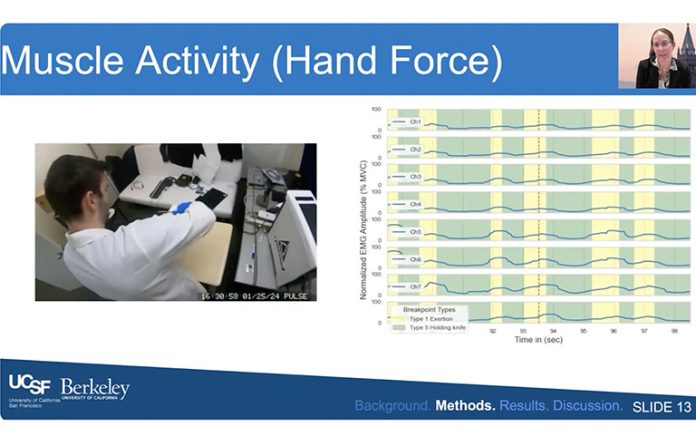
For each study, a group of third-party worker safety experts conducted interviews and site analyses, as well as recorded processing-line workers on the job. They measured muscle activity, posture, repetitive motions and other behaviors while comparing the risk of upper-extremity pain and MSDs for workers operating at higher and lower speeds.
The team found that 81% of poultry-processing workers and 46% of pork-processing workers faced an increased risk of developing an MSD. Also, a higher piece rate – the number of meat parts a worker handles per minute – was associated with a greater MSD risk.
Harris said the researchers observed that multiple facilities haven’t implemented long-established ergonomics best practices, some published by OSHA as early as 1993.
Additionally, she discussed the potential negative impact of a common practice in which workers experiencing MSD pain consistently received first-aid treatment such as ice, over-the-counter pain medication and tape without seeing a medical professional.
“What happens over time is not only does that pain develop into an injury, but it also means that people aren’t going to report their pain and symptoms anymore,” Harris said. “Because if they really want to go to a doctor and they’re just getting first aid that doesn’t seem to help anyway, and it’s something they could just do at home, then they might lose confidence that they could actually see a medical provider.
“And so, they just stop letting people know that they’re in any pain until the pain gets to a point where they actually can’t work.”
In March, USDA announced plans to “formalize” faster line speeds initially allowed at certain processing facilities as part of a trial period. The agency also said it no longer would require plant operators to submit worker safety data.
Harris cautioned that if “staffing levels were lowered, then the number of people at risk” of MSDs “would be even higher and the amount of hazard that we would measure would be even higher.”

