

By: Superior Glove, leading safety glove innovator
Introduction
From cotton to nylon to aramids, string-knit safety gloves offer various levels of hazard protection and are typically classified by their gauge – ranging from seven to 21. But what’s glove gauge and how does it affect glove performance?
What’s a glove gauge?
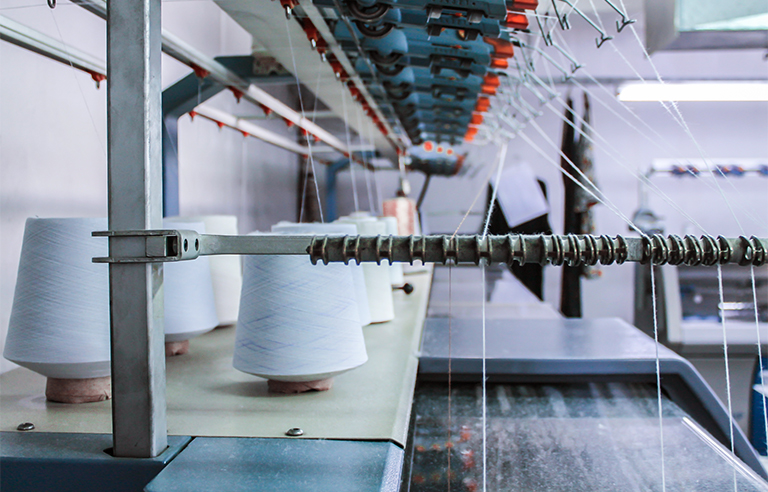
Gauge refers to the number of stitches per inch of knit material. As the number of stitches increases, so does the gauge. This means the yarn is thinner, allowing for a thinner glove. When there are fewer stitches per inch of yarn, the yarn is thicker and thus the glove is thicker.
Note: Although gauge refers to yarn, you’ll often hear the term glove gauge. This carries the same meaning. It’s simply a shorthand way to refer to glove thickness.
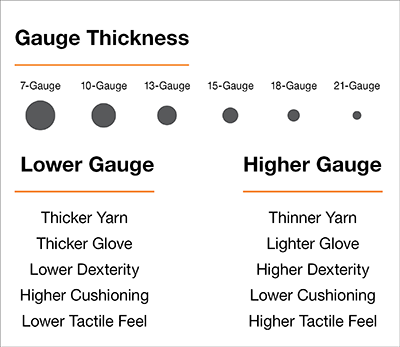
One might assume that lower-gauge equals lighter and higher-gauge equals heavier – but, in fact, the opposite is true. Lower-gauge gloves are thicker, more durable and less dexterous. By comparison, higher-gauge gloves are lighter, less durable and offer more dexterity. Refer to the chart below for a quick reference of glove gauge vs. glove performance.
Let’s explore this further.
How gauge affects glove performance
No one gauge is better than the other. It all depends on the tasks and hazards for which they’re needed. Knowing how glove gauge affects protection, dexterity and durability can help you choose the right protection for your team.
Glove gauge and protection
Traditionally, workers have relied on lower-gauge gloves for high-risk tasks involving cut and puncture hazards, as they provide a thicker barrier from penetrating the material. However, thicker gloves make precision work impractical as they lack dexterity and tactile feel, often leading workers to remove their protection and increase the risk of injuries. As a result of technological advancements in manufacturing yarn, we can now integrate high levels of mechanical protection like extreme cut resistance into higher-gauge gloves.
Glove gauge and dexterity
Dexterity, also referred to as range of motion, is the ease at which a task can be performed. Workers will often choose to remove gloves because they lack the required dexterity to work comfortably and efficiently, especially when it comes to precision work.
Higher-gauge gloves (18- to 21-gauge) are more dexterous because they’re thinner and lighter, so they offer more flexibility and a higher tactile feel. This makes them ideal for tasks that require fine motor skill and precision work.
Medium-gauge gloves (13- to 15-gauge) sit between in their thickness. They offer more cushioning than higher-gauge gloves and more dexterity than lower-gauge gloves. This allows a happy balance between the benefits and tradeoffs of higher- and lower-gauge gloves.
Lower-gauge gloves (seven- to 10-gauge) are less dexterous, because they’re thicker and less flexible and have a lower tactile feel. These make them a better option for heavy material handling that requires more cushioning but less dexterity.
Glove gauge and durability
Glove durability often refers to the glove’s longevity or wear-life. Generally, lower-gauge gloves are more durable because they’re thicker. This means there’s more material present to wear out. This is why lower-gauge gloves are often the preferred option for tasks that are rough or abrasive.
However, glove gauge isn’t the only factor that affects glove durability. Additives such as palm coating can also significantly improve durability of high-gauge gloves, which may be the deciding factor when working with tasks that also require more dexterity and precision work.
Understanding glove gauge can help you make informed decisions when choosing safety gloves for the job at hand. And with advancements in yarn technology and palm coatings, you no longer have to compromise on safety or performance.
Ready to find what you’re looking for? Explore Superior Glove’s wide range of string-knit safety gloves and other products – and request free samples.
Browse Superior Glove products and request free samples

