

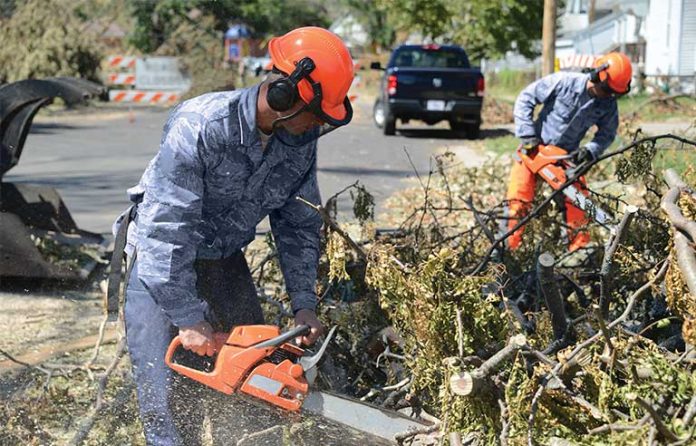
Between wildfires in the West and hurricanes in the South and Southeast, the contiguous United States last year experienced 20 weather/climate events that each caused at least $1 billion in damage. That event total includes tornadoes, severe storms, and heat and cold waves. It’s also the third highest recorded total ever by the National Oceanic and Atmospheric Administration’s National Centers for Environmental Information.
In the aftermath of devastating weather events, tens of thousands of storm recovery workers respond to help the affected communities. A wide variety of potential hazards await.
“One of the main challenges around storm recovery is you don’t know what you’re getting into until you get started,” said Ian Madison, senior manager of safety at the New Orleans-based utility company Entergy. “You’ve got a lot of widespread damage. There’s a lot of variables that are going on.”
Proper training and constant communication can ensure worker readiness and awareness during each step of the recovery process, Madison and other experts say.
Associate Editor Barry Bottino discusses this article in the March 2022 episode of Safety+Health‘s “On the Safe Side” podcast.
A wide range of hazards
Just as severe weather events can vary from coast to coast, so can the many dangers they leave behind for recovery crews.
Christopher Lawver, acting director of the Office of Emergency Management and Preparedness in OSHA’s Directorate of Technical Support and Emergency Management, said those hazards can be categorized as biological (e.g., bodily fluids, sewage, standing water), environmental (animals, insects), chemical (spills and leaks) and electrical (downed power lines). More specifically, the hazards can include:
- Carbon monoxide from portable generators
- Damaged gas lines and other compromised infrastructure
- Vehicle traffic, including traffic control
- Heat or cold stress
- Exposure to mold, asbestos or lead in buildings
- Falls from height
- The use of power tools
Cory Worden, a safety advisor for the City of Houston Health Department, explained that the concerns go beyond the obvious.
“On one hand, you’ve got the occupational part of it,” he said. “Then you’ve also got the need for really heightened situational awareness. Every time there’s a different disaster, there’s lots of things that come up that people didn’t see coming.”
That includes widespread floodwaters, which southern Texas experienced after Hurricane Harvey in August 2017.
“It’s like we talk about with the COVID-19 pandemic,” Worden said. “We want to control all the variables that we can. That’s less we have to face off with later when the clock is ticking.”
Phases of recovery
In his role as systems safety officer on Entergy’s storm team, Madison manages what he calls the three phases of storm recovery: mobilization assessment, restoration and protracted operations.
In anticipation of forecasted weather events, the Incident Command System – used by public agencies to manage emergencies, often in concert with private entities – is initiated, and resources such as workers and equipment are brought into the area. Challenges include housing the thousands of workers who are arriving, unknown travel conditions and communication issues.
“During Hurricane Laura (which struck Louisiana in August 2020), it was very difficult for several days to get in touch with folks because all the cell towers were gone,” Madison said.
When recovery workers arrive on scene after a disaster, he added, many want to help as quickly as possible.
“That can manifest in making poor decisions if you’re rushing, if you’re ignoring policies, procedures and safeguards that are put in place to ensure the work you’re doing – which does inherently have risk – can be done safely,” Madison said.
During the restoration phase, when services are starting to come back online, electrical contact injuries can be common, Madison warned. Another hazard can be the potential for violence directed at recovery workers from frustrated customers.
Additionally, with traffic signals and stop signs down, motor vehicles are often being directed “by a hand and finger pointing,” Madison explained. “It’s a time when communication and miscommunication can be a challenge.” This can lead to vehicles striking workers.
The third phase is when recovery work stretches from days into weeks, and sometimes longer. The results can be fatigue, corner cutting, lack of focus, time pressures, and frustration from customers and media if critical infrastructure is impacted. On some occasions, the latter can lead to physical violence directed at workers.
Focus on training
During recent severe weather events, Madison said one particular training exercise has paid dividends. “For the past two years, we have mocked tabletop drills that have come shockingly close to what we’ve actually experienced in the field,” he said. “The more you put into those drills and preparations and scenarios – physically getting people into a room, 100% focused – the more real you make it for everyone involved.”
That training doesn’t have to “come with a lot of fanfare” to be effective. Resources are abundant when it comes to storm recovery. On its Emergency Preparedness and Response webpage, OSHA offers more than 100 fact sheets, QuickCards and other resources to help educate employers and workers.
Along with preparedness training from the Federal Emergency Management Agency, local, regional and state emergency management agencies are good resources for training programs.
“The more proactive we are, the less that can actually go wrong when it happens,” Worden said.
Page 2 of 2
Constant communication
During Hurricane Harvey, Worden was working for a health care system and wrote daily updates that were distributed across the organization.
The updates covered topics such as driving and electrical hazards, along with personal protective equipment needed for employees returning to their flooded homes. Some of those workers walked through water in their yards and into open manholes or swimming pools.
Worden’s goal was simple: “Just keeping up with the hazards and being able to communicate that,” he said. “It gets people information that’s consistently being updated, but it also prevents complacency.” In the aftermath of a severe storm, conditions are constantly changing, making communication a critical piece in the recovery puzzle.
“It’s really at the forefront when we’re talking about protecting the health and safety of employees who are out there doing this work,” Lawver said. “It is imperative to have a communications plan going into it.”
FEMA’s Ready.gov website offers various tips on developing a crisis communication plan, including understanding all potential audiences. It also features a diagram of contact and information centers, as well as resources for communicating during a crisis.
Daily communications such as toolbox talks, safety huddles, briefings, etc., are a way to keep work crews updated and alert to changes in conditions.
“Do those consistently once the response has started,” Worden said. “The next day, there could be a new situation. In Harvey, the storm moved away, then it came back.”
Lawver said ensuring communications reach all employees in the language they understand best is a necessary step in the process. In addition, communicating roles and responsibilities for all workers can help alleviate confusion.
Out of their element
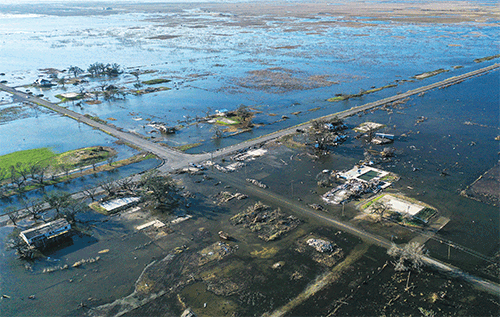
Photos: U.S. Department of Defense
Some workers travel long distances to assist after a storm. This is common in industries such as utilities. However, it can add to the preparation needed for those traveling from the upper Midwest to the Deep South, for example.
Madison grew up in Michigan but now lives in Texas. “The conversations around chiggers and snakes, those weren’t common,” he said of his home state. “We try to get everyone acclimated from a knowledge perspective about what they may see.”
The preparation for work crews far from home also includes information about equipment, PPE and what they may experience in an unfamiliar environment.
“It’s really important to anticipate where it is you’re going and also understand some of those things that are endemic to that area,” said Lawver, who warned of working in hot or cold environments without acclimatization, as well as putting in long shifts and workweeks.
Madison added: “They know the job, but they may not be cognizant or competent around the environment they’re working in.”
This often calls for sending digital training materials to contractors, vendors and others who will be assisting.
“We’re sending everything from COVID policies to heat exhaustion hydration tables, lightning policies to switching/tagging/grounding processes,” Madison said. “We do our best to inform and make those individuals who are coming into our network knowledgeable of the rules, requirements and local hazards.”
Small employers, big issue
A severe storm often can be more troublesome for small and medium-sized employers who don’t have the resources of a larger organization. Employers with small safety teams should approach storm recovery and return to work just as large employers do.
Keeping up with weather and travel conditions is something Worden does regularly as part of a municipal team. Government agencies that can provide that information are invaluable during a recovery period.
“Can your workforce get to work?” Worden asked. “If you’re a facility or a manufacturer, especially if you’re a smaller company, there’s a pretty good chance you’ll have to proactively reach out to those organizations and request that information.
“It’s a good idea to find those points of contact and build those bridges early.”

