Every OSHA investigation offers an opportunity for
using what comes to light to help prevent similar
incidents.
At the 2022 NSC Safety Congress & Expo in September,
OSHA staffers highlighted three investigations – and the
lessons learned – during the agency’s “Most Interesting
Cases” Technical Session.
The panel for the session included:
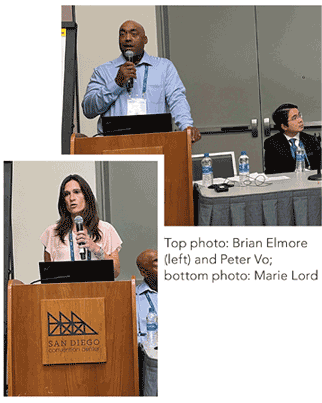
- Brian Elmore, an OSHA inspector based in Omaha, NE
- Marie Lord, assistant area director of the OSHA office in Marlton, NJ
- Peter Vo, safety engineer in OSHA’s Houston South area office
Here are the cases they presented.
Page 2 of 4
Case #1: Shelving collapse in a cold storage warehouse
A 33-year-old worker died after an extensive set of shelves, or racking, collapsed.
The facility, which stores frozen or prepared meat products, uses turret trucks – a type of powered industrial truck. The trucks operate in an automated fashion while in the aisles through use of a radar-wire system, but need drivers to get them to and from the aisles.
On the evening of Dec. 12, 2020, a turret truck was in the process of being switched from manual mode to automated operation when it struck one of the uprights of a rack. Even though the truck was moving only 5 mph, it damaged the 231-foot racking system enough to trigger a collapse. The ensuing chain reaction sent much of the 1.5 million pounds of inventory off the shelves.
The collapse crushed the victim, who was under the shelves 200 feet away from the impact and in the process of retrieving product. Another employee was injured and hospitalized, according to OSHA’s inspection report.
The racking collapsed so quickly that “the victim had little to no reaction time to get clear,” Elmore said.
OSHA actions: The agency issued one serious violation under its General Duty Clause and a $13,653 fine, which was reduced to $9,600 after an informal settlement.
Resolution: The employer installed bollards and other impact barriers in the facility. The voluntary standard ANSI MH16.1-2012 calls for such protections on warehouse racking.
The company no longer allows employees to go under shelves to retrieve product. Additionally, product retrieval work was moved to aisles where turret trucks aren’t permitted.
Other improvements: A new training system and weekly audits to identify any potentially damaged racking, and enhanced reporting systems.
LESSONS LEARNED:
Protect warehouse structures from impact. “It’s imperative that we understand that racking being hit at any speed could cause warehouse racking to collapse,” Elmore said. “We need to address those potential hazards.”
Hazards associated with powered industrial trucks aren’t always nearby. Although PIT-related hazards usually affect workers in close proximity to the equipment, Elmore said this incident shows that even employees working hundreds of feet away can be in danger.
Look at work practices and hazard identification. After an initial hazard identification is complete, Elmore said employers and workers should continually evaluate for hazards. “Powered industrial truck operators need to be aware of work going on in their area and any potential hazards,” he added.
Page 3 of 4
Case #2: Lockout/tagout-related amputation
A 50-year-old sanitation worker lost part of his right middle finger while attempting to clean a dough machine.
The employee, working an overnight shift, had been employed by a snack foods manufacturer for about a year – including six months as a temporary worker. He had worked at this particular facility for six weeks.
At his previous location with the company, he would clean the dough machine after it was disassembled and taken to another room. On the night of the incident, he was attempting to clean the machine while it was still on the factory floor.
The employee was scraping off dough from a hopper when the machine turned on and cut off part of his finger.
Lord said the company didn’t train its sanitation employees on authorized lockout/tagout procedures, and didn’t give them locks or ensure locks were used.
“The employer only told the sanitation employee, ‘Make sure the machine is off,’” Lord said. “They never showed him how to do it. They never gave him a lock. This was true for all the cleaning that sanitation workers did in their overnight shifts.”
OSHA actions: The agency issued two serious, one willful and one repeat citation to the manufacturer, which had been cited multiple times in the past for lockout/tagout issues. One of those citations stemmed from another amputation, Lord noted. The initial fines totaled $206,019, but were later reduced to $152,934 by an administrative law judge. In addition, the citations were changed to three serious violations and one repeat violation.
LESSONS LEARNED:
Lord said the takeaways from this case are from the enhanced settlement agreement that OSHA entered into with the company. That agreement affected four locations in OSHA’s Region 2 (three in New Jersey and one in New York), but had a “trickle-down effect,” Lord said, to the company’s other facilities around the country.
Conduct safety audits. The agreement requires at least two safety audits, led by an outside consultant, each year. Those audits cover lockout/tagout, as well as machine guarding and forklift safety.
Implement a safety and health program. The company was required to implement a safety and health program based on OSHA guidelines and OSHA Publication 3071 (Job Hazard Analysis).
Hire personnel with authority to oversee safety. The company had to hire a full-time safety manager for each of its manufacturing facilities and a corporate safety director. Before the amputation, the company had a corporate safety and health manager who said he developed a lockout/tagout audit program. However, Lord said the manager “had no authority to enforce that the audits were done.” That was under the purview of a plant manager, “who had no idea about lockout/tagout.”
Train employees in a language they understand. All of the manufacturer’s employees in the four Region 2 locations, from those in the corporate offices to those working in the factories, had to undergo safety training. That included temporary employees and contractors. “So everyone knew what their responsibility was for health and safety,” Lord said. That training also was provided in different languages. The facility where the amputation occurred had employees who spoke primarily Spanish or Vietnamese.
Start a safety committee. The agreement required the company to develop a safety and health committee, consisting of management, employee and union representatives. The company had to give the committee resources, and the committee had to provide reports. “The settlement agreement was the takeaway here,” Lord said. “It helped ensure no one else would suffer this type of injury.”
Page 4 of 4
Case #3: Crane collapse
A pair of brothers were killed when a crane boom collapsed on their truck along Interstate 10 near Beaumont, TX.
The employer, a pile driving company, was contracted to install supports for an elevated section of the highway, part of an I-10 expansion. On April 22, 2021, employees were attempting to drive a concrete piling into the ground but were unsuccessful.
Before moving on to attempt another pile driving, the employees had to retrieve a piece of equipment out of the ground with the crane. The crane’s boom, however, wasn’t configured according to the manufacturer’s specifications. A 40-foot section was in the wrong place.
Vo said the company chose not to reconfigure the crane to save time and money.
“[The company’s] owner said he used his configuration multiple times and never encountered any problems,” Vo added. “He believed his configuration would be as good as the manufacturer’s. He was wrong. Putting the 40-foot section [in the wrong spot] made the crane boom weaker and vulnerable to collapse.”
Additionally, the company miscalculated – by nearly 5,000 pounds – the weight the crane was trying to lift. Further, the employees were trying to “side pull” a load instead of lifting it straight up, a technique that Vo said is prohibited by the American Society of Mechanical Engineers. The side pulling, the miscalculated weight and the misconfigured crane boom all contributed to the deadly collapse.
OSHA actions: The agency issued five citations (three willful and two serious) and fines totaling $212,599. After an informal settlement, the citations were changed to two willful and two serious violations, while the fines were reduced to $77,824.
LESSONS LEARNED:
Always follow safety instructions from the manufacturer’s operation manual, including crane assembly. Contact the manufacturer for consultation, if needed.
Properly calculate the weight being lifted and only pick up objects that are directly under the crane boom – no side pulling.
Remember that even if you perform a task multiple times without incident, that doesn’t mean it’s a safe operation.
Always follow OSHA and industry-recognized standards.