

Update: Read the newest Top 10 list plus highest penalties, top 10 by region, and a Q&A with OSHA’s Patrick Kapust in the December 2022 issue of Safety+Health
Fall Protection – General Requirements (1926.501) has been OSHA’s most frequently cited standard for the past 11 fiscal years, and the other standards that make up the agency’s “Top 10” list have largely remained unchanged.
Although the data may seem stagnant, Patrick Kapust, deputy director of OSHA’s Directorate of Enforcement Programs, reminds safety professionals that the figures reinforce the importance of staying vigilant about worker safety and health. This especially rings true now, amid the evolving – and, perhaps, waning – COVID-19 pandemic.
“We’ll continue to adapt to workplace scenarios in order to meet our mission, by developing our programs and initiatives either through National Emphasis Programs or directives or memos,” Kapust said.
“We’ll adapt,” he repeated.
Here, Safety+Health presents Top 10 data for FY 2021 (which concluded Sept. 30), the “penalty box” of the year’s largest fines and an exclusive interview with Kapust, who presented the data virtually in October during the NSC Safety Congress & Expo.
Most cited violations, fiscal year 2021
Click images to enlarge
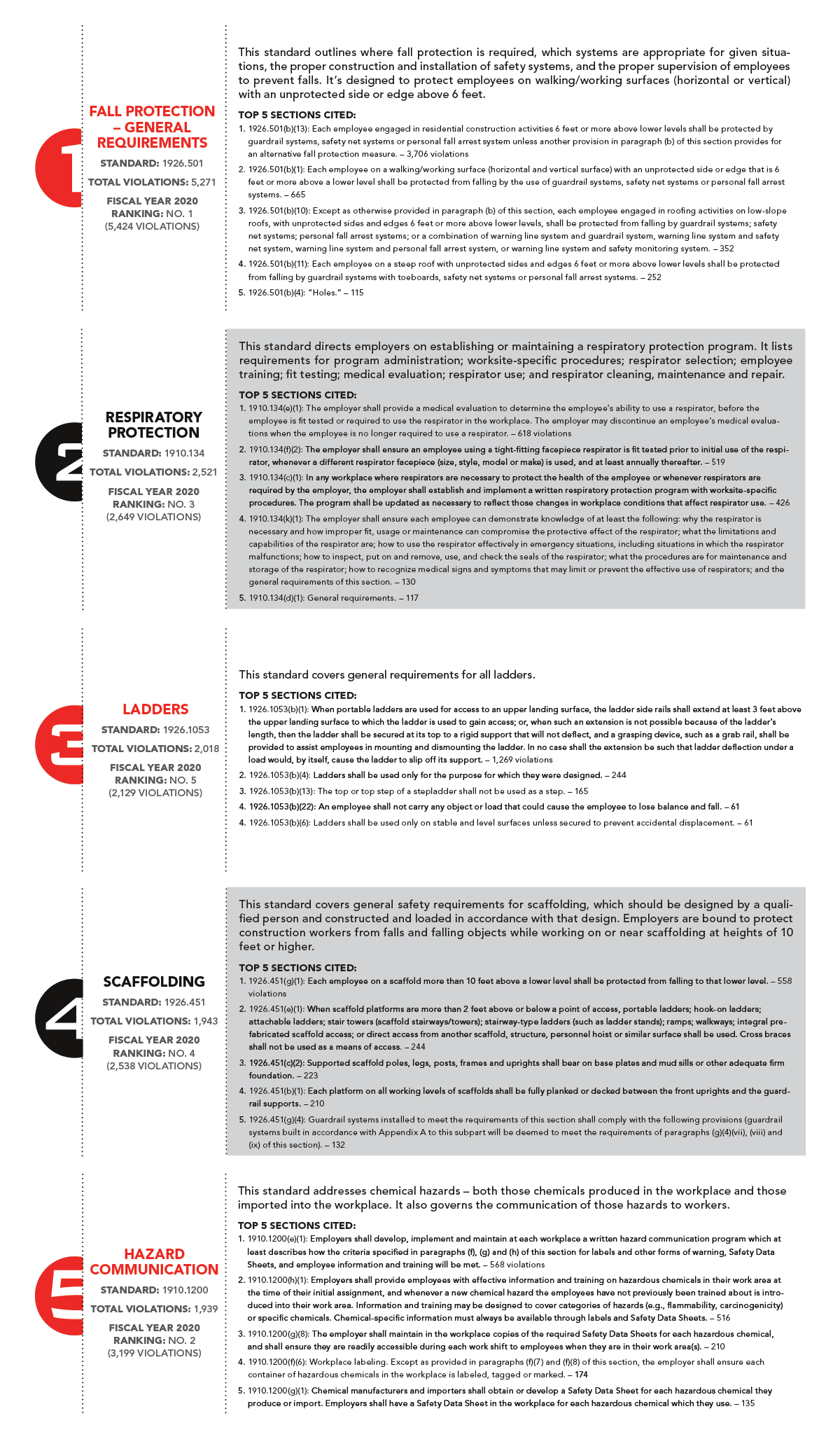
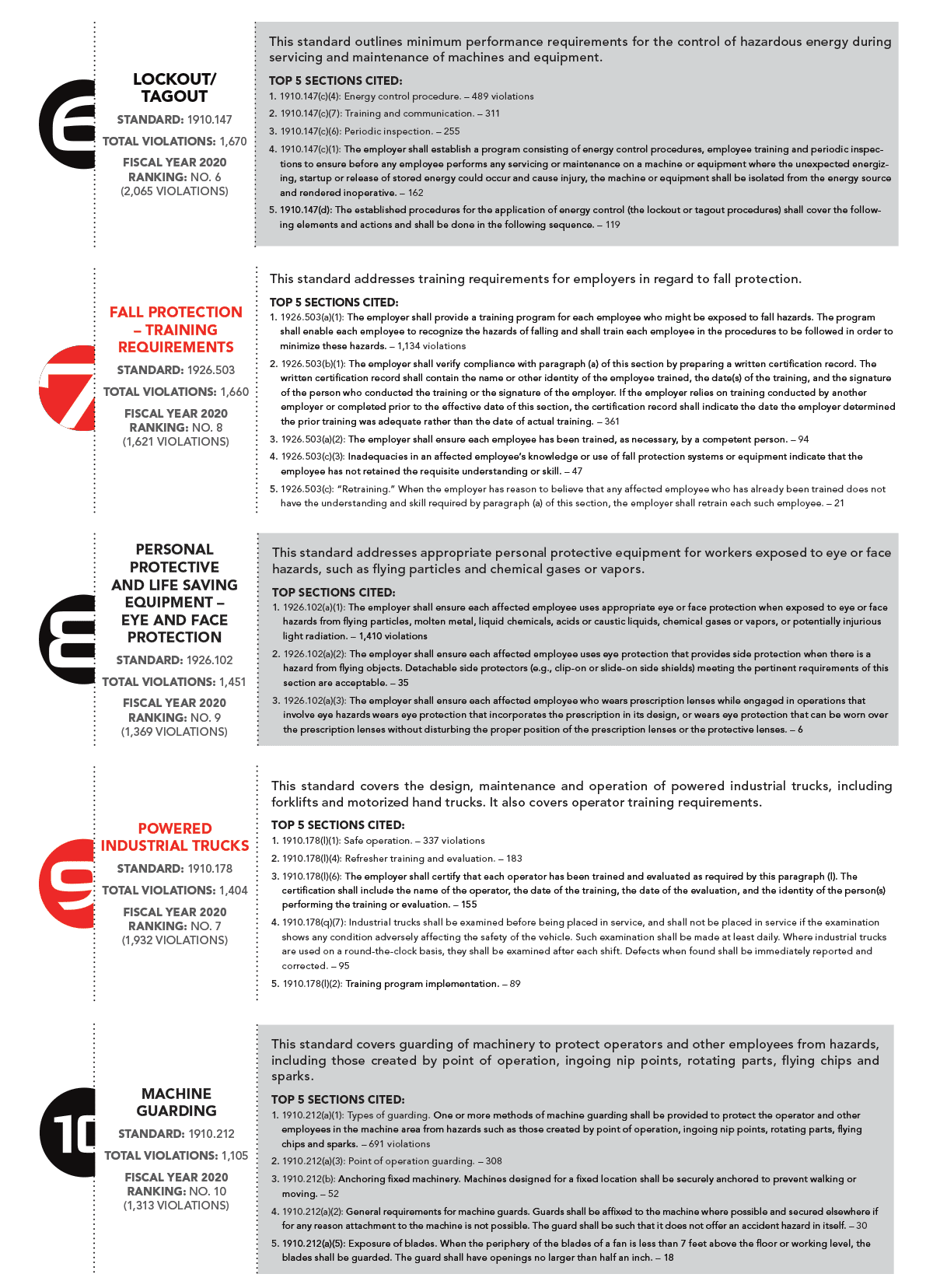
*Tables based on OSHA Information System data from Oct. 1, 2020, to Sept. 30, 2021. Data is current as of Nov 8.
Top 10 “serious” violations, fiscal year 2021
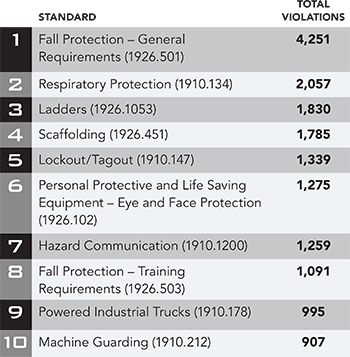 OSHA defines a “serious” violation as “one in which there is a substantial probability that death or serious physical harm could result, and the employer knew or should have known of the hazard.”
Top 10 “willful” violations, fiscal year 2021
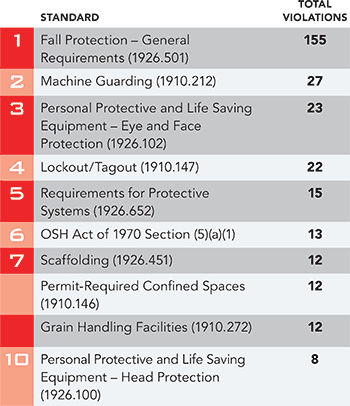
OSHA defines a “willful” violation as one “committed with an intentional disregard of or plain indifference to the requirements of the Occupational Safety and Health Act and requirements.”
Tables are based on OSHA Information System data from Oct. 1, 2020, to Sept. 30, 2021. Data is current as of Nov 8.
| Citation Solutions: Visit the websites of Safety+Health advertisers offering products and services to help you avoid OSHA’s Top 10 most cited violations. | Next: Top 10 penalties > |
Penalty Box
This list of OSHA’s highest proposed monetary penalties in fiscal year 2021 comprises those stemming from a single incident or related incidents in which one or more employers are alleged to have failed to adhere to safe work practices. These failures put workers at risk – in some cases fatally. The following information was gathered from press releases issued by federal OSHA between Oct. 1, 2020, and Sept. 30, 2021, as well as data provided by the agency’s communications team.
(Note: Dollar amounts may be reduced as part of a settlement agreement or litigation.)
$1.256 million
EMPLOYER: Atlantic Coast Utilities LLC/Advanced Utilities Inc., and its successors, including Sterling Excavation LLC
LOCATION: Wayland, MA (OSHA Region 1)
BUSINESS TYPE: Utility provider
INSPECTION TRIGGER: Fatalities
EVENT: Two workers at a sewer repair worksite suffered fatal injuries after being struck and pushed into an unprotected trench by a dump truck driving in reverse. OSHA investigators found that the company neglected to provide training to avoid work-related hazards while failing to conduct worksite inspections related to hazard recognition.
MAJOR CITATIONS: Atlantic Coast Utilities et al. was cited for 12 serious violations, seven willful violations and one repeat violation. The citation included the agency’s first egregious violation issued under then-acting OSHA administrator Jim Frederick. An agency press release indicates OSHA has inspected Atlantic Coast Utilities and owner Laurence Moloney – as well as his predecessor and successor companies – multiple times.
$1.221 million
EMPLOYER: General Aluminum Manufacturing Co.
LOCATION: Ravenna, OH (OSHA Region 5)
BUSINESS TYPE: Aluminum parts manufacturer
INSPECTION TRIGGER: Complaint
EVENT: A worker was killed after being struck by the barrier door of a machine. The door closed on the worker’s head as he loaded a part into the machine. OSHA inspectors identified issues related to machine guarding and lockout/tagout at the facility, alleging the organization was mindful of the problems but did not act to correct them.
MAJOR CITATIONS: General Aluminum Manufacturing was cited for four serious, eight willful and one repeat violation. The company also was placed in OSHA’s Severe Violator Enforcement Program after the fatality inspection as well as two other inspections stemming from employee complaints to inspectors.
$676,808
EMPLOYER: Didion Milling Inc.
LOCATION: Cambria, WI (OSHA Region 5)
BUSINESS TYPE: Grain milling facility
INSPECTION TRIGGER: Fatality
EVENT: OSHA determined that a manager entered an unsafe grain silo to clear corn clogging the bin. An external process to remove the corn already was underway, and the agency says the process should have resumed for multiple days before anyone was allowed to enter. The worker was fatally engulfed – two months after a significant grain shelf collapse at the facility nearly triggered the fatal engulfment of another worker.
MAJOR CITATIONS: OSHA cited Didion Milling for 10 serious and four willful violations.
$595,474
EMPLOYER: Foundation Food Group Inc.
LOCATION: Gainesville, GA (OSHA Region 4)
BUSINESS TYPE: Poultry processing plant
INSPECTION TRIGGER: Fatalities
EVENT: Six employees died after a freezer malfunctioned and released colorless, odorless liquid nitrogen into the air, displacing the oxygen in the room. OSHA inspectors found that three workers who entered the freezer room shortly after their shift began had never received training on the fatal effects of nitrogen exposure. Other workers subsequently entered the room and were overcome. According to an agency press release, at least 12 other workers were injured and required hospitalization.
MAJOR CITATIONS: Determining that Foundation Food Group and two additional organizations responsible for operations at the facility neglected to implement safety procedures necessary to prevent the leak, OSHA issued 15 serious, three willful and three other violations.
$502,050
EMPLOYER: Clarke Products Inc.
LOCATION: Waco, TX (OSHA Region 6)
BUSINESS TYPE: Plastics and plumbing fixture manufacturer
INSPECTION TRIGGER: Complaint
EVENT: OSHA determined that the employer failed to use required machine guarding and sufficient fall protection. Two years earlier, the agency cited the organization for failure to ensure the use of machine guards.
MAJOR CITATIONS: Clarke Products was cited for eight repeat, four serious and two willful violations.
$451,079
EMPLOYER: Fabcon Precast LLC
LOCATION: Grove City, OH (OSHA Region 5)
BUSINESS TYPE: Homebuilder
INSPECTION TRIGGER: Fatality
EVENT: A worker was using an air chipper to remove a jam from under an open pneumatic concrete mixer discharge door. Upon the release of the jam, the door closed on the worker’s head and neck, trapping and fatally crushing him.
MAJOR CITATIONS: Fabcon Precast was cited for eight serious and three willful violations, including those related to OSHA’s General Duty Clause, confined space permit requirements and lockout/tagout.
$448,303
EMPLOYER: Bentoli Inc.
LOCATION: Elgin, TX (OSHA Region 6)
BUSINESS TYPE: Farm supply merchant wholesaler
INSPECTION TRIGGER: Fatality
EVENT: A worker died after being trapped in a machine, according to a news report. OSHA did not issue a press release for the incident.
MAJOR CITATIONS: OSHA cited Bentoli for three serious, three willful and two other violations. Two of the serious violations were related to the agency’s standard on lockout/tagout, while the other was related to the standard on powered industrial trucks. Lack of fall protection also was cited.
$419,347
EMPLOYER: Trinity Rail Maintenance and Services Inc.
LOCATION: Hugo, OK (OSHA Region 6)
BUSINESS TYPE: Rail car products and services provider
INSPECTION TRIGGER: Fatalities
EVENT: OSHA inspectors found that the company failed to require permits to allow entry into a rail car and to complete permits to perform work inside a confined space. These conditions contributed to two worker deaths, the agency concluded. After one worker became unresponsive after entering a natural gas rail car to clean the space, a colleague also was overcome while attempting a rescue. Although the workers ultimately were recovered, they later were pronounced dead at a nearby hospital.
MAJOR CITATIONS: Trinity Rail was cited for 11 serious and two willful violations.
$404,811
EMPLOYER: Carework Construction LLC
LOCATION: Wyckhoff, NJ (OSHA Region 2)
BUSINESS TYPE: Contractor
INSPECTION TRIGGER: Planned inspection
EVENT: Among its findings, OSHA discovered that the contractor violated standards for fall protection in addition to those for head, eye and face protection.
MAJOR CITATIONS: Carework Construction was cited for one willful and two repeat violations.
$394,402
EMPLOYER: Family Dollar Stores Inc.
LOCATION: Paterson, NJ (OSHA Region 2)
BUSINESS TYPE: Discount retailer
INSPECTION TRIGGER: Complaint
EVENT: Blocked aisles and exit routes, improper wiring design, and poor protection and management of compressed gases were observed at Family Dollar Store No. 10330, which also was found to be in violation of OSHA’s standard on injury and illness recordkeeping and reporting (Subpart 1904).
MAJOR CITATIONS: Family Dollar Stores was cited for three repeat, two willful and one serious violation.
| Citation Solutions: Visit the websites of Safety+Health advertisers offering products and services to help you avoid OSHA’s Top 10 most cited violations. | Next: Q & A with OSHA's Patrick Kapust > |
Q & A with OSHA’s Patrick Kapust
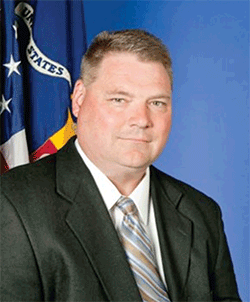
Preliminary data for OSHA’s Top 10 most cited violations for fiscal year 2021 was announced Oct. 12 during the 2021 NSC Safety Congress & Expo in Orlando, FL. Weeks later, Patrick Kapust, deputy director of OSHA’s Directorate of Enforcement Programs, spoke with Safety+Health Associate Editor Kevin Druley to discuss the list, as well as actions safety and health professionals can take to help correct hazards in their workplaces.
Safety+Health: Why do you believe Fall Protection – General Requirements has remained in the No. 1 spot for so long?
Kapust: Fall hazard violations continue to top the list because they are present in so many workplaces, whether from the use of stairways, ladders, scaffolding, unprotected floor holes, wall openings or any activity carried out on an elevated work surface. Employers need to evaluate their workplaces to identify and abate fall hazards on a continual basis – not just once at the beginning of a job or process. Each year, the agency hosts a national campaign to raise awareness and encourage fall prevention. For more information on that program, you can visit our website at osha.gov/stop-falls.
S+H: Electrical – General Requirements (1910.303) and Electrical – Wiring Methods (1910.305) each held spots on the list when you first presented the Top 10 in November 2011. These days, neither standard is a mainstay on the list. In what ways have employers been effective in mitigating electrical hazards?
Kapust: Well, OSHA is pleased to see that Electrical – General Requirements and Wiring Methods are not on the Top 10 list, although it must be noted that both remain in the top 15 frequently issued citations. From our work, we’ve discovered that those employers with successful electrical safety programs focus first on employee training and safe work practices. Additionally, qualified employees are able to recognize electrical hazards and implement effective abatement strategies through comprehensive preventive maintenance and self-inspections.
S+H: How has the COVID-19 pandemic affected enforcement activities? What influence have you seen in regard to Respiratory Protection?
Kapust: During the pandemic, OSHA developed new ways of prioritizing and conducting inspections, such as remote inspections via phone or fax, as well as responding to complaints and referrals while ensuring the protection of our own field staff. OSHA area offices have continued to use their resources to fulfill mission-essential functions that allow flexibility and discretion so that our field offices can maximize OSHA’s impact in securing safe workplaces for workers and agency staff in these evolving environments. OSHA addressed enforcement of existing general industry health and safety standards, especially those in high-risk industries like meat and poultry processing. Previously, the agency developed policies that allowed certain enforcement discretions – which have now been rescinded – due to nationwide shortages of personal protective equipment, quarantines, business shutdowns and limited availability of contractors to perform medical services. OSHA’s website provides information on COVID-related whistleblower activity and the number of complaints received.
The pandemic had a slight influence on Respiratory Protection violations. In relation to the total number of inspections made during the pandemic, the percentages of cited Respiratory Protection violations increased from 5.3% in FY 2020 to 6.5% in FY 2021. The agency continues to provide compliance assistance through media outreach, guidance documents and memoranda to aid employers in protecting their workers from SARS-CoV-2 – the virus that causes COVID-19.
S+H: Previously, you mentioned that the agency would continue to take a balanced approach to enforcement under the Biden administration. After nearly a year, to what extent has that been the case?
Kapust: Enforcement, training and compliance assistance remain key elements in OSHA’s approach to workplace safety and health. I strongly believe that each component drives and supports the others. OSHA has the White House’s support to move forward with key safety and health initiatives such as heat illness prevention in indoor and outdoor work settings. The enforcement program office continues to work closely with other directorates within OSHA to develop strategic approaches to ensure the protection of America’s workers.
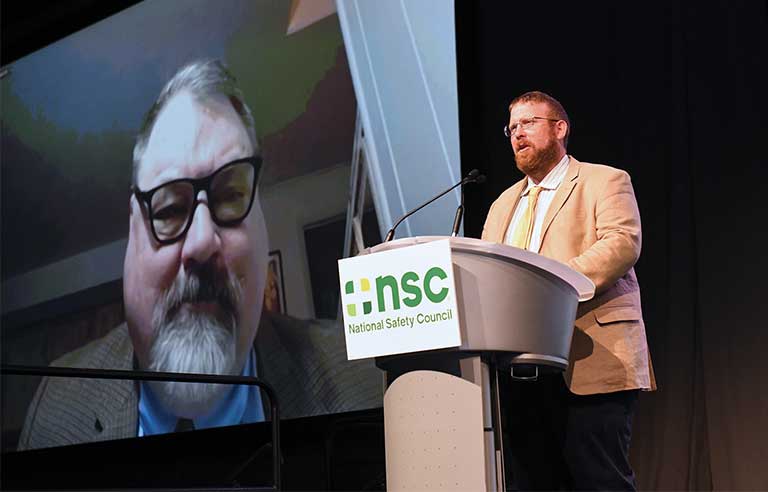
Safety+Health Associate Editor Kevin Druley (right), was joined via Zoom by Patrick Kapust, deputy director of OSHA’s Directorate of Enforcement Programs, to present the Top 10 list of most cited violations for fiscal year 2021 at the 2021 NSC Safety Congress & Expo in Orlando, FL.
S+H: In your experience, how much do press releases about citations prompt employers to abate workplace hazards or raise their awareness of hazards?
Kapust: Because OSHA cannot inspect every workplace, we must be creative in the way that we message our mission to reach as many workplaces as possible. We know that other employers pay attention to our press releases, especially when it impacts someone in their industry or in their local community. Press releases can impact a company’s business profile, their ability to bid for work and their competition in the marketplace. We hope the press releases will encourage others to take proactive steps to address safety and health before an incident occurs or before a compliance safety and health officer arrives to conduct an inspection. And there are a lot of excellent resources available to do just that, including the Onsite Consultation Program and OSHA’s compliance assistance specialists.
S+H: What updates can you give on national enforcement initiatives or National Emphasis Programs that are in the works? What kind of impact can NEPs have on the Top 10?
Kapust: In January, OSHA released its revised National Emphasis Program for respirable crystalline silica, targeting employers in construction, general industry and maritime, and enforcing OSHA’s silica standards that were issued in 2016. Although silica exposures are wide-ranging among America’s workplaces, the agency does not expect citations for violations of the new silica standard to make the Top 10 list of OSHA’s most frequently cited violations.
In March, a new national enforcement initiative was issued to address the COVID-19 pandemic and its effect on America’s workers. The NEP was revised in July after the agency issued an emergency temporary standard for COVID-19 in health care, and will be reviewed again after issuance of the new ETS for COVID-19 vaccinations, testing and face coverings among employers with 100 or more employees.
In September, OSHA issued a nationwide enforcement initiative to prevent and protect employees from serious heat-related illnesses while working in hazardous indoor or outdoor environments. Working conditions that have resulted in serious heat-related illnesses occur in all major industry sectors, including general industry, construction, agriculture and maritime. An increase in worker illnesses and fatalities is possible if outdoor and indoor work settings are without adequate climate-controlled environments. However, the agency does not expect future citations for heat-related hazards issued under the General Duty Clause to make the Top 10 list of OSHA’s most frequently cited violations.
S+H: What advice would you give to employers to help them avoid being a statistic in next year’s Top 10 list?
Kapust: Employers should review their work processes and determine the hazards in their workplace by completing job hazard analyses, encourage employees to report workplace hazards and unsafe conditions, train employees to recognize hazards related to the Top 10 list, and expand training to other workplace hazards. Employers should also review their injury and illness logs and implement measures to eliminate identified hazards.
S+H: Where can employers turn for help to avoid violations that appear on the Top 10 list?
Kapust: Small and medium-sized employers who need assistance with identifying and correcting hazards in the workplace should contact the nearest OSHA consultation program. That can be found on our website at osha.gov/consultation. They can request an onsite, no-cost visit from that program.
S+H: What haven’t I asked that you think S+H readers should know?
Kapust: I’d just like to reiterate that, as safety and health professionals, your readers are on the front lines to make a difference for workers in America and to really make an impact on the way employers approach workplace safety and health. As workplaces return to full capacity, in some cases with fewer employees, it is even more important to make sure that safety and health remain a critical part of reentry procedures.
| Citation Solutions: Visit the websites of Safety+Health advertisers offering products and services to help you avoid OSHA’s Top 10 most cited violations. | Next: Citation Solutions > |
Citation Solutions
The following Safety+Health advertisers offer solutions to help you avoid OSHA’s “Top 10” most-cited violations.
1. Fall Protection – General Requirements (1926.501)
2. Respiratory Protection (1910.134)
3. Ladders (1926.1053)
4. Scaffolding (1926.451)
5. Hazard Communication (1910.1200)
6. Lockout/Tagout (1910.147)
7. Fall Protection – Training Requirements (1926.503)
8. Personal Protective and Lifesaving Equipment – Eye and Face Protection (1926.102)
9. Powered Industrial Trucks (1910.178)
10. Machine Guarding (1910.212)

