Scooters offer kids some fun and a feeling of independence as they head out of the house. But with both manual and electric scooters becoming more common, it’s important not to leave safety behind.
“There’s more and more scooters on the road these days, and we’re seeing more and more injuries in the ER,” said Yomna Nassef, an emergency room physician in New York City.
Recent data from the Consumer Product Safety Commission shows that ER visits related to e-scooters climbed to 25,400 in 2020. That’s a 229.9% jump from 2017, when 7,700 were reported.
Here are some tips to help make sure your child’s next scooter ride is a safe one.
Ready or not?
When are kids old enough to ride a scooter?
Carter Clement is a pediatric orthopedic surgeon in New Orleans and member of the Pediatric Orthopaedic Society of North America.
He recommends age 8 as a good starting point, because lack of balance and coordination in kids younger than that “really makes falls pretty much inevitable.”
Still, some kids learn at an accelerated pace, so Clement offers this litmus test: “If you’re thinking of bending that rule for the 8-year cutoff and your kid seems pretty coordinated, I think if they are not yet comfortable and safe riding a bike, then it is almost certainly not time to introduce a scooter.”
Check it out
Before your kid jumps on, check scooters for damage. The CSPC recommends looking at the handlebars, brakes, throttle, lights, tires, cables and frame. Make sure all are damage-free to prevent your child from losing control while riding. Bells and horns need to work, too.
Then, your child should be comfortable using the brakes and familiar with the proper stopping distance, which may vary by scooter.
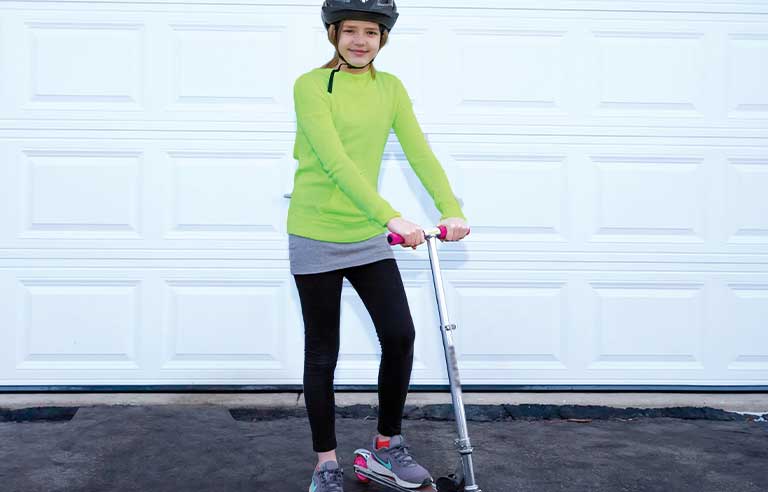
And don’t forget: All riders should wear a helmet.
“This is really the easiest thing that everyone can do to avoid a serious injury,” Nassef said. “Make sure that your helmet is properly fitted.” Find tips at nhtsa.gov/document/fitting-your-bike-helmet.
The National Safety Council recommends scooter riders wear sturdy, close-toed shoes – and consider using knee and elbow pads as well as wrist guards.
Make it a safe ride
Whether the scooter is foot-powered or electric, kids need to know how to use the steering and brakes – and they should never speed, the American College of Emergency Physicians says.
Adds Nassef: “Getting used to the scooter at lower speeds before you start speeding up is important.”
Clement said the optimal surface for children is a flat, paved or tightly compacted dirt area in a park or somewhere motor vehicles aren’t allowed.
Sidewalks are an option, “but I’ve also seen multiple kids getting hit by cars backing out of driveways, so sidewalks certainly do make me nervous,” Clement said.
When it comes to riding e-scooters on public roads, local laws vary. The ACEP reminds riders to be on the lookout for road hazards such as small bumps, potholes and loose gravel, as well as pedestrians. If kids are riding in a more populated area, they need to be mindful of traffic and parked cars as well.
Clement suggests young riders master the use of manual scooters before trying electric ones. “All sorts of new safety questions come into concern because you can move faster, you can move more easily, it’s easier to get yourself somewhere where there are cars and other dangers,” he said. “So, not only for physical boundaries but also just for mental reasons, I think it’s good to be older. An electric scooter should certainly be introduced after you feel like your child is very safe and comfortable and solid on the rules of a manual scooter.”
On the move
Remind kids what the NSC says about maneuvering a scooter:
- Keep both hands on the handlebars.
- Avoid distractions.
- Only one person per scooter.
- No stunts.
The CPSC says jumps and bumps may damage the scooter and create an injury risk for the rider. Teach kids to slow down and lean back when they see a bump in the path.
On an e-scooter? Remember that it’s small and quiet, so drivers in larger vehicles and pedestrians may not see or hear you. Riders should use their scooter’s bell or horn to alert others and refrain from making abrupt, unpredictable movements.
And, of course, kids are more likely to ride safely when adults supervise. “The best-case scenario is that they’re always within sight of their parents,” Clement said. “That’s the number one way to avoid any surprises.”