
Whether you’re in the grocery store, at church, or at the bank or hair salon, you’ve likely seen a family caregiver.
What do caregivers look like? Just like you. They can be a relative, a neighbor, a friend or a community member. As AARP puts it, caregivers can be “families of kin or families of choice.”
According to AARP’s 2020 report “Caregiving in the U.S.,” an estimated 53 million adults – more than 1 out of 5 Americans – serve as caregivers to a fellow adult or a child with special needs. That total is up from 43.5 million people in 2015. “
There are more and more people in this situation,” said Amy Goyer, who serves as a caregiving expert for AARP, a nonprofit organization that advocates for people 50 and older. “You can be thrown into it if your loved one has a sudden crisis or a catastrophic health event. Or, it can be gradual support over time.”
Goyer has experienced both situations with her late parents. Her mother suffered a stroke at age 63, while her father had Alzheimer’s disease, which she called “a long, 12-year journey.”
Caregiving can involve taking on plenty of responsibility, along with the stress and pressure that comes with it.
Self-care that suits you
Providing care to a loved one can often lead people to put their own health and well-being on a back burner.
According to the Family Caregiver Alliance, caregivers report issues such as lack of sleep, poor diet, not exercising, working when sick, and postposing or forgoing their own medical care. “
Many people experience isolation and all the things that drain you,” Goyer said. “You may have a lack of resources and support. There’s stress and fear.”
That’s why Goyer encourages caregivers to make time to care for themselves, even if it’s just 10 minutes of exercise or relaxation. (See How to fill your tank.)
I can’t find two hours, but I can find 10 minutes,” she said.
Page 2 of 3
Costs of caregiving
The Family Caregiver Alliance, on its Caregiver.org website, lists nine questions to ask yourself and other family members about the financial aspects of becoming a caregiver. They include: How will you pay your own rent/mortgage if you’re moving in to care for somebody? How will you be reimbursed for added expenses of caregiving? What happens if the person you’re caring for runs out of money?
Those questions and the others are valuable because, according to AARP, 45% of caregivers experience at least one of the following five financial impacts: ⁃
- Stopped saving money
- Took on more debt
- Used up personal short-term savings
- Left bills unpaid/paid bills late
- Borrowed money from family or friends
In addition, your time is an important commodity. Six out of 10 caregivers said they worked full time in addition to providing care, according to AARP. Meanwhile, more than 30% spend 21 or more hours a week on caregiving duties. “That’s a part-time job,” Goyer said. “If you’re already working, now you’ve got two jobs.”
AARP encourages caregivers who work to meet with their supervisor and human resources department to discuss resources that are available to help, such as flexible work options, counseling support services, paid time off or family leave, or elder care referrals.
Page 3 of 3
The right information
To many people, the health care system can cause plenty of confusion. This can be especially true for caregivers, says Jo-Ana Chase, an assistant professor at the University of Missouri’s Sinclair School of Nursing.
Chase studied 40 caregivers of patients who were sent home from a hospitalization with home health care. Although the patients received information when they were discharged, many caregivers said they had to learn on their own when caring for someone.
“A large majority said they didn’t really receive a lot of useful information or any information at all when an older adult was discharged,” Chase said.
Instead, they often relied on Google, asking friends or finding caregiver support groups.
Chase noted in the study that written instructions and demonstrations from home health professionals were an important aspect of training caregivers. “
We had one caregiver who really appreciated the written instructions,” Chase said. “He would show it to his loved one and say, ‘Look, I’m not making this up.’”
Caregivers also should keep a list of questions and take it to every medical appointment. “
Don’t be afraid to ask,” Chase said. “The information you receive will be helpful. It will give you greater confidence.”
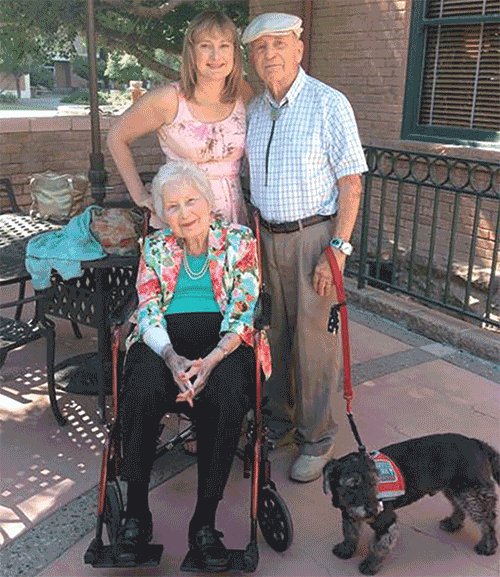
Amy Goyer (center), a blogger for AARP, was a caregiver for her mother, Patricia, and her father, Robert.
Find the rewards
Amy Goyer (center), a blogger for AARP, was a caregiver for her mother, Patricia, and her father, Robert.
To provide additional care for her parents, Goyer relocated to Arizona. Although she took on greater responsibility, she also earned greater rewards by spending more time with her mother and father.
“The biggest reward for me was being there for my loved ones who needed me,” Goyer said. “I couldn’t solve every crisis. I could not be a perfect caregiver. There is no such thing.”
She urges caregivers to find small joys that will endure as lasting memories. When she would tuck her mother in each night, Goyer remembers her mother’s bright smile.
“That image is forever in my mind,” she said. “I knew she felt safe and secure and loved and cared for.” Goyer, who began her professional life as a music therapist, used music regularly to help her father.
“I know I made his life better,” she said.