
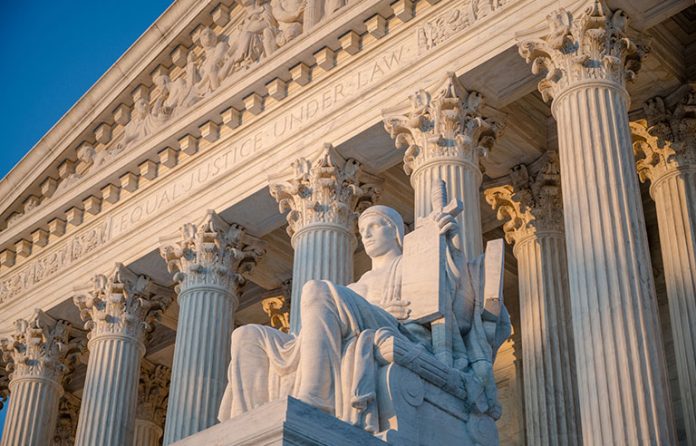
Washington — The U.S. Supreme Court issued a stay of OSHA’s emergency temporary standard on COVID-19 vaccination, testing and masking, with a 6-3 decision Jan. 13.
The high court, which heard arguments on Jan. 7, sent the case back to the 6th U.S. Circuit Court of Appeals for a hearing on the merits of the ETS. OSHA, however, officially withdrew its ETS on Jan. 26.
OSHA published the ETS in the Nov. 5 Federal Register, giving employers with 100 or more employees 30 days to develop, implement and enforce a mandatory COVID-19 vaccination policy – or provide a policy that gives workers the choice to get vaccinated or undergo weekly COVID-19 testing.
The 5th U.S. Circuit Court of Appeals issued a stay of that ETS on Nov. 12, but the 6th Circuit ended that stay with a 2-1 decision Dec. 17.
In re-issuing a stay, the Supreme Court’s majority contends that although COVID-19 “is a risk that occurs in many workplaces, it is not an occupational hazard in most.” The justices continue: “COVID-19 can and does spread at home, in schools, during sporting events and everywhere else that people gather. That universal risk is no different from the day-to-day dangers that all face from crime, air pollution or any number of communicable diseases.”
In their dissent, Justices Stephen Breyer, Elena Kagan and Sonia Sotomayor note that people can choose to avoid places such as sporting events or restaurants, but many people have to go into a physical workplace and face the risk of exposure to COVID-19.
The majority opinion states that targeted regulations would be permissible, giving the examples of those concerning researchers who work with the virus that causes COVID-19 or employees who work in “particularly crowded or cramped environments.”
The justices write: “The danger in such workplaces differs in both degree and kind from the everyday risk of contracting COVID-19 that all face.”
Supreme Court majority opinion
Who has the authority?
One of the major issues of contention was whether Congress, in the Occupational Safety and Health Act of 1970, gave OSHA the authority to issue such an ETS.
Drawing from Section 6(c)(1) of the act, the dissenters write that the ETS “falls within the core of the agency’s mission: to ‘protect employees’ from ‘grave danger’ that comes from ‘new hazards’ or exposure to harmful agents.”
The majority, meanwhile, writes that it expects Congress “to speak clearly when authorizing an agency to exercise powers of vast economic and political significance.” The justices contend that Congress authorized safety standards for the workplace – not public health – and that the current Congress has enacted COVID-19 legislation but hasn’t charged OSHA with promulgating this ETS.
“Permitting OSHA to regulate the hazards of daily life – simply because most Americans have jobs and face those same risks while on the clock – would significantly expand OSHA’s regulatory authority without clear congressional authorization,” the majority opinion states.
Page 2 of 2
‘Major questions’ doctrine
The need for Congress “to speak clearly” is part of what’s known as the “major questions” doctrine, which Justice Neil Gorsuch covered in a concurring opinion.
That doctrine, sometimes known as the “major rules” doctrine, has been used in recent Supreme Court cases. It’s typically reserved for administrative action involving significant political or economic considerations.
The “major questions” doctrine typically also involves the nondelegation doctrine, a principle stemming from Article I of the Constitution, that Congress cannot delegate its authority to other entities. Therefore, under that doctrine, if Congress hasn’t explicitly permitted an agency to take an action, the courts must strike down that action.
Critics of the “major questions” doctrine say that puts administrative decisions into the hands of unaccountable judges. That doctrine is also a reversal from what’s known as the Chevron Deference.
That legal test, set forth by the Supreme Court in a 1984 decision, held that the judiciary was supposed to defer to agencies as long as its actions were deemed reasonable and as long as Congress hadn’t clearly addressed the particular issue at hand.
The dissenters alluded to the Chevron Deference in their opinion, noting that the justices don’t have expertise in workplace safety and health. They also write that judges aren’t accountable to anyone, unlike those in the executive or legislative branches.
In a press release, Labor Secretary Marty Walsh expressed disappointment in the high court’s decision, adding that OSHA “will do everything in its existing authority to hold businesses accountable for protecting workers,” citing the General Duty Clause and the agency’s COVID-19 National Emphasis Program.
In a statement, the National Safety Council said it, too, was “disappointed” by the decision.
“COVID-19 continues to devastate the American people, and employers must play a role in fighting this deadly virus,” Lorraine Martin, NSC president and CEO, said. “Despite the court’s ruling, we call on employers everywhere to take responsibility for the safety of their workers by implementing a requirement for vaccination or testing, and exhausting any and all proven safety countermeasures such as masking, frequent handwashing, improved ventilation systems, and regularly disinfecting work surfaces.”